













Bendamustine: Understanding Its Mechanism, Dosing, and Clinical Role
Key takeaways
- Bendamustine is a bifunctional alkylating chemotherapy with a unique structure combining nitrogen-mustard activity with a benzimidazole ring.
- It damages DNA through alkylation and cross-linking, disrupting DNA replication and ultimately promoting cancer-cell death.
- Bendamustine is administered intravenously, with dosing and infusion duration determined by the indication and treatment regimen.
- It is an established treatment for chronic lymphocytic leukemia (CLL) and indolent B-cell non-Hodgkin lymphoma (NHL).
- Myelosuppression, infections, nausea, fatigue, and infusion-related reactions are among the important adverse effects requiring monitoring.
- Renal and hepatic function, blood counts, prior treatment, and treatment-related toxicity should be considered when determining whether therapy can safely continue.
- Bendamustine remains an important component of combination treatment strategies in hematologic malignancies, although its use has evolved with the introduction of targeted and immune-based therapies.
Bendamustine, also known as bendamustine hydrochloride, is an intravenous alkylating chemotherapy and bifunctional mechlorethamine derivative with a distinctive benzimidazole ring. It damages cancer-cell DNA through alkylation and cross-linking and is primarily used in chronic lymphocytic leukemia (CLL) and indolent B-cell non-Hodgkin lymphoma (NHL).
This article aims to review bendamustine’s mechanism of action, dose, administration, supportive-care requirements, pharmacokinetics, clinical-trial findings, safety profile, approval status, and current role in oncology. Because bendamustine is a hazardous cytotoxic chemotherapy, preparation, dilution, and patient-specific dosing should follow the applicable prescribing information and institutional oncology protocol.
Bendamustine Key Facts
- Generic name: Bendamustine hydrochloride
- Drug class: Alkylating agent; bifunctional mechlorethamine derivative
- Administration: Intravenous
- Main FDA-approved uses: Chronic lymphocytic leukemia and indolent B-cell non-Hodgkin lymphoma
- CLL dose: 100 mg/m² IV over 30 minutes on Days 1 and 2 every 28 days, up to 6 cycles
- Indolent B-cell NHL dose: 120 mg/m² IV over 60 minutes on Days 1 and 2 every 21 days, up to 8 cycles
- Mechanism: DNA alkylation and interstrand DNA cross-linking
- Major toxicities: Myelosuppression, infections, nausea, fatigue, vomiting, diarrhea, and infusion reactions
- Important serious risks: Tumor lysis syndrome, severe infection, PML, anaphylaxis, serious skin reactions, hepatotoxicity, and secondary malignancies
- Renal impairment: Do not use when creatinine clearance is <30 mL/min
- Hepatic impairment: Do not use in specified moderate-to-severe hepatic impairment
- Approval status: FDA approved; initial U.S. approval was in 2008.
What Is Bendamustine?
Bendamustine is a bifunctional alkylating chemotherapy that damages DNA and interferes with malignant-cell replication.
Its chemical structure contains a mechlorethamine/nitrogen mustard group, a benzimidazole ring, and a butyric acid side chain. The nitrogen mustard component is primarily responsible for forming electrophilic alkyl groups that react with DNA.
Bendamustine is FDA approved for:
- Chronic lymphocytic leukemia
- Indolent B-cell non-Hodgkin lymphoma that has progressed during or within 6 months of treatment with rituximab or a rituximab-containing regimen.
Although bendamustine is classified primarily as an alkylating agent, its benzimidazole component and distinctive cellular effects have led to descriptions of additional antimetabolite-like and apoptotic activity. The exact mechanism is not completely defined.
Bendamustine Mechanism of Action
Bendamustine primarily produces DNA alkylation and cross-linking.
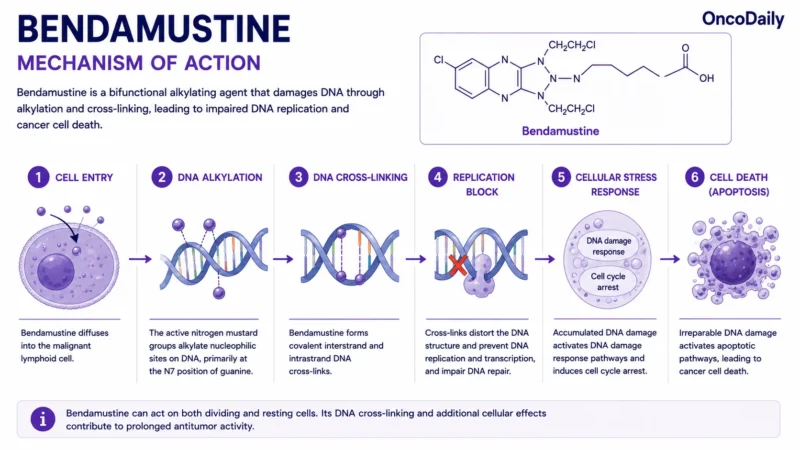
The mechanism can be summarized as:
- Bendamustine enters the malignant cell.
- Its electrophilic mechlorethamine groups react with nucleophilic sites on DNA.
- This produces covalent DNA cross-links, particularly interstrand cross-links.
- DNA replication and repair become impaired.
- Accumulated DNA damage activates cellular stress pathways and can ultimately result in cell-cycle arrest and apoptosis.
Unlike some conventional alkylating agents, bendamustine can act against both dividing and quiescent cells. The FDA labeling notes that its exact mechanism remains unknown, despite its established ability to produce interstrand DNA cross-links.
What Is the Dose of Bendamustine?
Bendamustine dosing is indication- and regimen-specific.
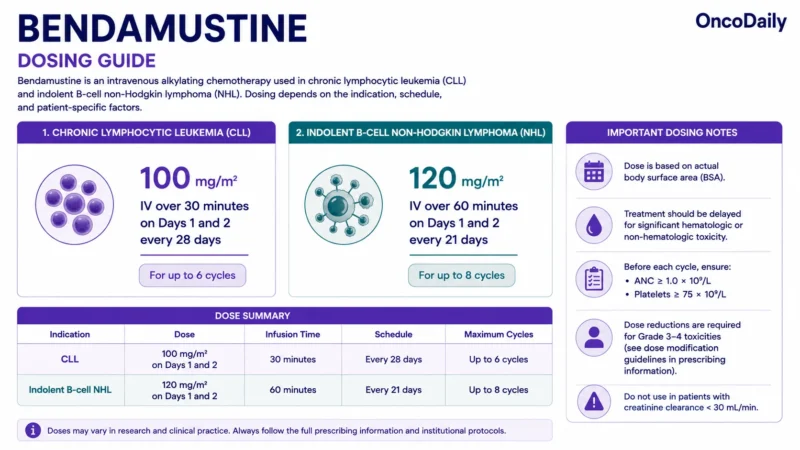
Chronic Lymphocytic Leukemia
The recommended dose is:
100 mg/m² IV over 30 minutes on Days 1 and 2 of a 28-day cycle, for up to 6 cycles.
Indolent B-Cell Non-Hodgkin Lymphoma
For indolent B-cell NHL that has progressed during or within 6 months of rituximab-containing treatment:
120 mg/m² IV over 60 minutes on Days 1 and 2 of a 21-day cycle, for up to 8 cycles.
These FDA-labeled doses should not be automatically applied to other bendamustine-containing regimens. In contemporary hematology practice, bendamustine is also used in combination regimens at protocol-specific doses.
How Is Bendamustine Administered?
Bendamustine is administered intravenously by trained healthcare professionals.
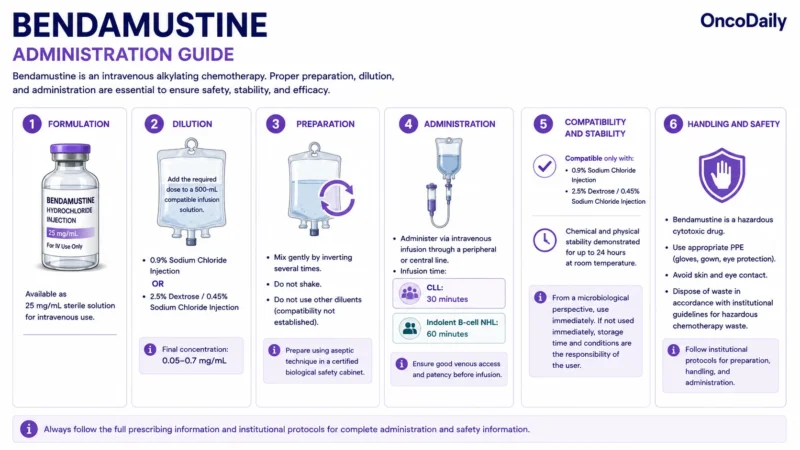
For the currently labeled bendamustine hydrochloride injection formulation, the drug is supplied as a 25 mg/mL solution and must be diluted before administration. The required dose is transferred into a 500-mL infusion bag containing either:
- 0.9% sodium chloride injection, or
- 2.5% dextrose/0.45% sodium chloride injection.
For the solution formulation, the final concentration should be 0.05–0.7 mg/mL. No other diluents have been demonstrated to be compatible with that formulation.
The labeled infusion durations are:
- CLL: 30 minutes
- Indolent B-cell NHL: 60 minutes.
Bendamustine is a hazardous drug and should be prepared and handled using appropriate cytotoxic-drug precautions.
Does Bendamustine Require an In-Line Filter?
There is no universal in-line-filter requirement specified in the FDA prescribing information for bendamustine hydrochloride.
Filter requirements should therefore be determined according to:
- The specific bendamustine formulation
- Manufacturer instructions
- Institutional pharmacy policy
- The infusion system being used.
The more important formulation-specific requirement is appropriate dilution before IV administration.
Is Premedication Required?
Bendamustine does not require one universal premedication regimen for every patient.
However, antiemetic prophylaxis is commonly incorporated into treatment because nausea and vomiting are frequent adverse effects.
Premedication becomes particularly relevant if the patient has previously experienced an infusion reaction. The FDA label states that patients who experience Grade 1 or 2 infusion reactions may receive measures such as:
- Antihistamines
- Antipyretics
- Corticosteroids
during subsequent cycles to reduce the risk of recurrent or more severe reactions. Patients who experience Grade 3 or worse allergic-type reactions should not be rechallenged.
Patients at substantial risk of tumor lysis syndrome may also require preventive measures such as vigorous hydration and appropriate uric-acid–lowering therapy.
Are Dose Reductions Used?
Yes.
Bendamustine may require treatment delays or dose reductions because of hematologic or nonhematologic toxicity.
CLL
For Grade 3 or greater hematologic toxicity:
- Reduce to 50 mg/m² on Days 1 and 2
- If Grade 3 or greater toxicity recurs, reduce to 25 mg/m² on Days 1 and 2.
For clinically significant Grade 3 or greater nonhematologic toxicity:
Reduce to 50 mg/m² on Days 1 and 2.
Indolent NHL
For Grade 4 hematologic toxicity:
- Reduce to 90 mg/m² on Days 1 and 2
- If Grade 4 toxicity recurs, reduce to 60 mg/m² on Days 1 and 2.
For Grade 3 or greater nonhematologic toxicity:
- Reduce to 90 mg/m²
- If the toxicity recurs, reduce to 60 mg/m².
Treatment is generally delayed until significant toxicity improves and blood counts recover. Before restarting therapy, the label specifies recovery to approximately ANC ≥1 × 10⁹/L and platelets ≥75 × 10⁹/L.
What Is Known About Bendamustine Pharmacokinetics?
Bendamustine reaches its maximum plasma concentration near the end of the IV infusion.
It is highly protein bound, with approximately 94–96% protein binding, and has a steady-state volume of distribution of approximately 20–25 L.
After a 120 mg/m² IV dose administered over 1 hour:
- Parent-drug intermediate half-life: approximately 40 minutes
- M3 active metabolite terminal half-life: approximately 3 hours
- M4 active metabolite terminal half-life: approximately 30 minutes
- Clearance: approximately 700 mL/min.
Bendamustine undergoes extensive metabolism through hydrolytic, oxidative, and conjugative pathways. Two active minor metabolites, M3 and M4, are formed primarily through CYP1A2-mediated metabolism in vitro.
Approximately 50% of a radiolabeled dose was recovered in urine and approximately 25% in feces, although only a small proportion of urinary recovery represented unchanged bendamustine.
Are Renal or Hepatic Dose Adjustments Required?
Renal Impairment
The current FDA labeling states:
Do not use bendamustine in patients with creatinine clearance <30 mL/min.
The pharmacokinetic data indicate no clinically meaningful effect from mild-to-moderate renal impairment when creatinine clearance is ≥30 mL/min, while the pharmacokinetics in severe renal impairment have not been adequately characterized.
Hepatic Impairment
Bendamustine should not be used in patients with specified significant hepatic impairment.
The labeling advises against use in patients with:
- AST or ALT 2.5–10 × ULN with total bilirubin 1.5–3 × ULN, or
- Total bilirubin >3 × ULN.
Patients with milder hepatic abnormalities did not demonstrate clinically meaningful pharmacokinetic changes in the available data.
What Did Bendamustine Clinical Trials Show?
Bendamustine in Chronic Lymphocytic Leukemia
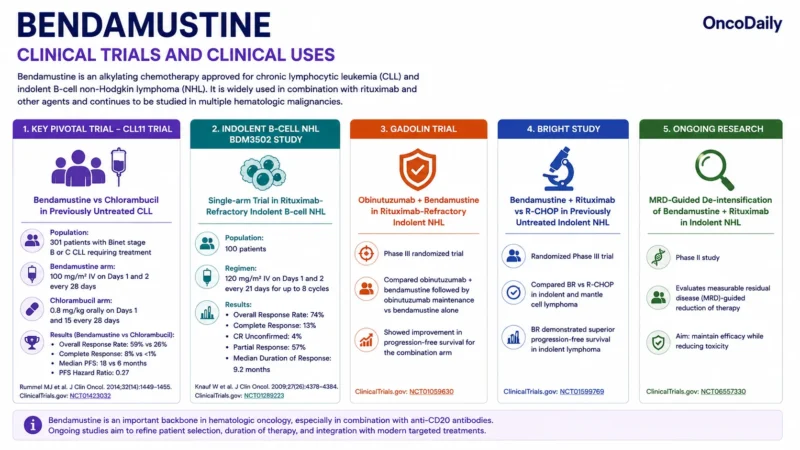
The pivotal FDA-supported CLL study was an open-label, randomized multicenter trial comparing bendamustine with chlorambucil in 301 previously untreated patients with Binet stage B or C CLL requiring treatment.
Patients received:
- Bendamustine 100 mg/m² IV on Days 1 and 2
- or chlorambucil 0.8 mg/kg orally on Days 1 and 15
every 28 days.
Bendamustine produced:
- Overall response rate: 59% vs 26%
- Complete response: 8% vs <1%
- Median PFS: 18 vs 6 months
- PFS hazard ratio: 0.27
compared with chlorambucil.
An earlier publication from this randomized Phase III study reported a higher response rate of 68% vs 31% and median PFS of 21.6 vs 8.3 months, reflecting different analysis populations and follow-up.
Bendamustine in Indolent B-Cell Non-Hodgkin Lymphoma
The FDA registration program included a single-arm study of 100 patients with indolent B-cell NHL that had progressed during or within 6 months of rituximab-containing therapy. Patients received bendamustine 120 mg/m² on Days 1 and 2 every 21 days for up to 8 cycles.
The study reported:
- Overall response rate: 74%
- Complete response: 13%
- Complete response unconfirmed: 4%
- Partial response: 57%
- Median duration of response: 9.2 months.
These data supported the role of bendamustine in rituximab-refractory indolent B-cell NHL.
GADOLIN Trial
The Phase III GADOLIN study evaluated obinutuzumab plus bendamustine followed by obinutuzumab maintenance versus bendamustine alone in patients with rituximab-refractory indolent NHL.
The study demonstrated the potential benefit of combining bendamustine with an anti-CD20 antibody and helped establish the broader clinical role of bendamustine-based chemoimmunotherapy in relapsed indolent lymphoma.
Current Research
Bendamustine continues to be studied in selected settings. One example is NCT06557330, a Phase II study investigating measurable residual disease-guided de-intensification of bendamustine plus rituximab in indolent NHL.
The study is evaluating whether patients who achieve deep responses can safely receive fewer cycles of bendamustine-based treatment.
Is Bendamustine FDA Approved?
Yes.
Bendamustine received its initial U.S. approval in 2008. Current FDA labeling identifies two principal indications:
- Adult patients with chronic lymphocytic leukemia
- Adult patients with indolent B-cell non-Hodgkin lymphoma that has progressed during or within 6 months of rituximab or a rituximab-containing regimen.
NCI also confirms that bendamustine hydrochloride is FDA approved for CLL and the specified indolent B-cell NHL indication.
What Is the Current Role of Bendamustine?
Bendamustine remains an established chemotherapy option in B-cell hematologic malignancies, although its role has evolved as targeted therapies and immunotherapies have become increasingly important.
Its major clinical roles include:
- Chronic lymphocytic leukemia: an FDA-approved treatment, although modern CLL management increasingly relies on targeted agents such as BTK and BCL2 inhibitors.
- Indolent B-cell NHL: an established chemotherapy option, particularly in combination with anti-CD20 antibodies. Read more: Rituximab: Uses in Cancer, Side Effects, Dosages, Expectations, and More by OncoDaily
- Relapsed lymphoma: bendamustine-based combinations remain useful in selected patients.
- Investigational strategies: bendamustine continues to be evaluated in response-adapted and MRD-guided approaches.
Bendamustine therefore remains clinically relevant, particularly in lymphoma, despite the expansion of targeted and cellular therapies.
Watch more: Bendamustine in the Treatment of B-Cell Malignancies
What Are the Side Effects of Bendamustine?
Important adverse effects include:
- Neutropenia
- Leukopenia
- Lymphopenia
- Thrombocytopenia
- Anemia
- Nausea
- Vomiting
- Fatigue
- Diarrhea
- Fever
- Infection
- Pneumonia
- Rash
- Stomatitis
- Infusion reactions
- Hypersensitivity
- Tumor lysis syndrome
- Hepatotoxicity
- Renal toxicity
- Severe skin reactions
- Progressive multifocal leukoencephalopathy
- Secondary malignancies.
Myelosuppression
Myelosuppression is one of the most important toxicities of bendamustine.
In the clinical studies, substantial reductions occurred in:
- Neutrophils
- Lymphocytes
- Leukocytes
- Hemoglobin
- Platelets.
In the CLL trial, Grade 3/4 neutropenia occurred in 43% of bendamustine-treated patients, while Grade 3/4 leukopenia occurred in 28%.
In the NHL studies, Grade 3/4 decreases occurred in 60% for neutrophils, 56% for leukocytes, and 94% for lymphocytes.
CBC monitoring is therefore essential before and during treatment.
Infections
Bendamustine-associated lymphopenia and neutropenia can increase the risk of infection.
Reported infections include:
- Pneumonia
- Herpes zoster
- Urinary tract infection
- Upper respiratory infection
- Opportunistic infections
- Sepsis.
Reactivation of hepatitis B, cytomegalovirus, tuberculosis, and herpes zoster has also been reported. Appropriate screening, monitoring, prophylaxis, and treatment should be considered according to the patient’s clinical situation.
Progressive Multifocal Leukoencephalopathy
Progressive multifocal leukoencephalopathy (PML), including fatal cases, has been reported following bendamustine treatment, particularly when used with rituximab or obinutuzumab.
New neurologic, cognitive, behavioral, speech, gait, or visual symptoms should prompt consideration of PML.
Infusion and Hypersensitivity Reactions
Infusion reactions commonly include:
- Fever
- Chills
- Pruritus
- Rash.
Rarely, severe anaphylactic or anaphylactoid reactions can occur, particularly during later cycles.
Patients with severe reactions should not routinely be rechallenged.
Tumor Lysis Syndrome
Tumor lysis syndrome can occur, particularly during the first treatment cycle in patients with a high tumor burden.
Rapid tumor-cell destruction can produce:
- Hyperuricemia
- Hyperkalemia
- Hyperphosphatemia
- Hypocalcemia
- Acute kidney injury
- Potentially fatal metabolic complications.
Preventive strategies include appropriate hydration and close monitoring of blood chemistry.
Skin Reactions
Bendamustine has been associated with serious and occasionally fatal skin reactions, including:
- Stevens-Johnson syndrome
- Toxic epidermal necrolysis
- DRESS
- Bullous eruptions
- Severe rash.
Progressive or severe skin reactions require prompt evaluation and may require discontinuation of treatment.
Hepatotoxicity
Serious and fatal liver injury has been reported.
Liver chemistry tests should be monitored before and during therapy, particularly because some cases occur during the first few months of treatment. Hepatitis B reactivation and concomitant medications may contribute to hepatic injury in some patients.
Extravasation
Bendamustine extravasation can cause:
- Erythema
- Swelling
- Pain
- Inflammation
- Tissue injury.
Good venous access should be established, and the infusion site should be monitored during and after administration.
Secondary Malignancies
Premalignant and malignant conditions have been reported following bendamustine treatment, including:
- Myelodysplastic syndrome
- Acute myeloid leukemia
- Myeloproliferative disorders
- Nonmelanoma skin cancers.
Patients should receive appropriate long-term clinical surveillance.