













Bleomycin: Mechanism of Action, Dose, Administration, Clinical Uses, and Side Effects
Key takeaways
- Bleomycin damages DNA, producing single- and, to a lesser extent, double-strand breaks.
- It remains a key component of ABVD for Hodgkin lymphoma and BEP for testicular and ovarian germ-cell tumors.
- The FDA label recommends 10–20 units/m² IV, IM, or subcutaneously once or twice weekly for several systemic indications.
- Bleomycin can also be used as an intrapleural sclerosing agent for malignant pleural effusions.
- The most clinically important adverse effect is pulmonary toxicity, which may progress from pneumonitis to pulmonary fibrosis.
- Pulmonary toxicity becomes more frequent with cumulative doses above 400 units, although it can occur at substantially lower exposure.
- Bleomycin causes relatively little bone-marrow suppression compared with many other cytotoxic drugs, which helps explain its usefulness in multidrug regimens.
- Renal impairment can substantially reduce bleomycin clearance and requires dose adjustment.
Bleomycin is a glycopeptide antineoplastic antibiotic used in several cancers, particularly Hodgkin lymphoma and testicular germ-cell tumors, and in selected squamous cell carcinomas and malignant pleural effusions. It can be administered intravenously, intramuscularly, subcutaneously, or intrapleurally, depending on the indication. Bleomycin is FDA approved.
This article aims to review bleomycin mechanism of action, dose, administration, clinical-trial findings, pharmacokinetics, safety profile, and current role in cancer treatment.
Bleomycin Key Facts
- Generic name: Bleomycin sulfate
- Drug class: Glycopeptide antineoplastic antibiotic
- Administration: Intravenous, intramuscular, subcutaneous, or intrapleural
- Major oncology uses: Hodgkin lymphoma, non-Hodgkin lymphoma, testicular cancer, selected squamous cell carcinomas, and malignant pleural effusion
- Common combination regimens: ABVD for Hodgkin lymphoma and BEP for germ-cell tumors
- FDA-labeled systemic dose: 10–20 units/m² once or twice weekly, depending on indication
- Malignant pleural effusion: 60 units intrapleurally as a single dose
- Major toxicity: Pulmonary pneumonitis and pulmonary fibrosis
- Important cumulative-dose concern: Pulmonary toxicity increases substantially when total exposure exceeds approximately 400 units
- Approval status: FDA approved.
What Is Bleomycin?
Bleomycin is a mixture of cytotoxic glycopeptide antibiotics originally isolated from Streptomyces verticillus.
The FDA label lists bleomycin for the management of:
- Hodgkin lymphoma
- Non-Hodgkin lymphoma
- Testicular carcinoma
- Squamous cell cancers of the head and neck, penis, cervix, vulva, and other sites
- Malignant pleural effusion.
Its best-known modern roles are within ABVD, which combines doxorubicin, bleomycin, vinblastine, and dacarbazine for Hodgkin lymphoma, and BEP, which combines bleomycin, etoposide, and cisplatin for germ-cell tumors.
Bleomycin Mechanism of Action
Bleomycin’s antitumor activity is primarily related to DNA damage.
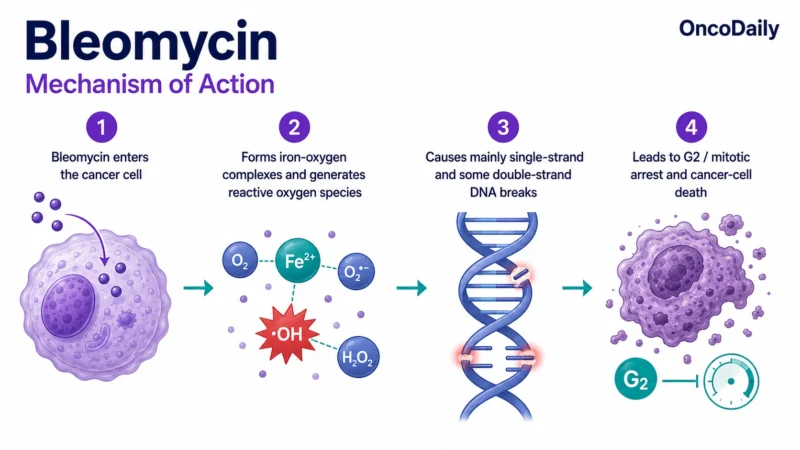
Its mechanism can be summarized in four stages:
- Bleomycin enters the cancer cell.
- It forms complexes with metal ions, particularly iron, and molecular oxygen.
- Reactive oxygen species are generated, producing predominantly single-strand and some double-strand DNA breaks.
- DNA synthesis is inhibited, cell-cycle arrest develops—particularly in G2 and mitosis—and sufficiently damaged cells undergo death.
Bleomycin may also produce lesser inhibition of RNA and protein synthesis.
When administered into the pleural cavity, its principal purpose differs: bleomycin acts as a sclerosing agent, causing inflammation and adhesion of the pleural surfaces to reduce recurrence of malignant pleural effusion.
Watch more: Explore bleomycin’s mechanism of action, resistance, and pharmacology in Bleomycin: Mechanism of Action
What Is the Dose of Bleomycin?
Bleomycin dosing depends on the cancer type and treatment regimen.
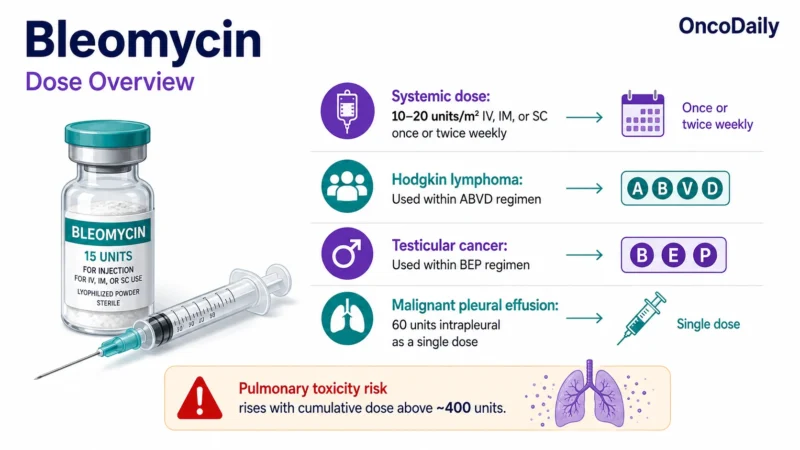
Hodgkin Lymphoma
The FDA label recommends:
Bleomycin 0.25–0.5 units/kg, equivalent to approximately 10–20 units/m², IV, IM, or subcutaneously once or twice weekly.
In the commonly used ABVD regimen, the bleomycin dose is protocol-specific and is administered alongside doxorubicin, vinblastine, and dacarbazine. NCI recognizes ABVD as an established Hodgkin lymphoma regimen.
Testicular Cancer
The labeled systemic dose is also:
10–20 units/m² IV, IM, or subcutaneously once or twice weekly.
In current germ-cell tumor practice, bleomycin is most familiar as part of BEP, with etoposide and cisplatin.
Squamous Cell Carcinoma and Non-Hodgkin Lymphoma
The labeled range is:
0.25–0.5 units/kg, or approximately 10–20 units/m², once or twice weekly.
Malignant Pleural Effusion
The FDA-labeled dose is:
60 units as a single intrapleural dose.
These doses are indication- and protocol-specific and should not be considered interchangeable.
How Is Bleomycin Administered?
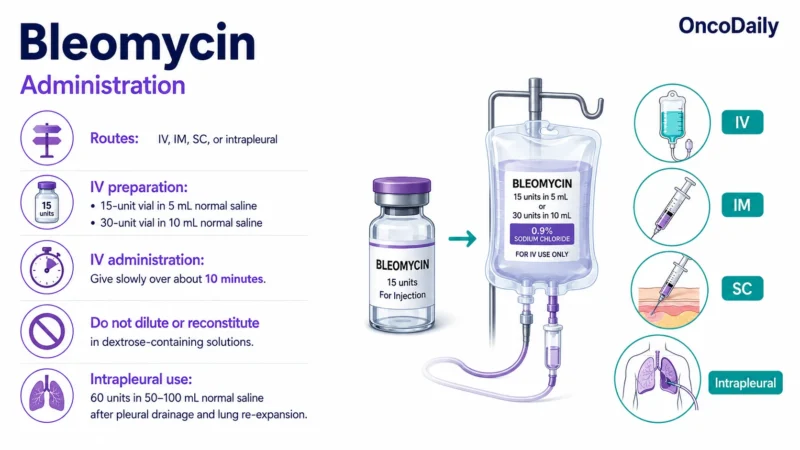
Bleomycin may be administered by:
- Intravenous injection
- Intramuscular injection
- Subcutaneous injection
- Intrapleural administration.
Intravenous Administration
For IV administration, the FDA label instructs reconstitution of:
- 15-unit vial in 5 mL of 0.9% sodium chloride
- 30-unit vial in 10 mL of 0.9% sodium chloride
The dose is then administered slowly over approximately 10 minutes.
The current label specifically advises not reconstituting or diluting bleomycin in D5W or other dextrose-containing solutions, because potency loss has been observed.
Intramuscular or Subcutaneous Administration
For IM or SC use, a 15-unit vial may be reconstituted with 1–5 mL, and a 30-unit vial with 2–10 mL, using an appropriate labeled diluent.
Intrapleural Administration
For malignant pleural effusion:
60 units are dissolved in 50–100 mL of 0.9% sodium chloride and administered through a thoracostomy tube after adequate drainage of pleural fluid and confirmation of lung re-expansion.
Does Bleomycin Require an In-Line Filter?
The FDA prescribing information does not specify a universal in-line filter requirement for conventional bleomycin.
Administration should follow:
- The specific product label
- Institutional chemotherapy procedures
- Route-specific preparation requirements
- The protocol for the complete treatment regimen.
Is Premedication Required?
Bleomycin does not have one universal routine premedication regimen for all patients.
However, an important historical safety precaution applies to lymphoma patients. Because an acute severe idiosyncratic reaction has been described, the FDA label recommends that lymphoma patients receive 2 units or less for each of the first two doses. If no acute reaction occurs, the usual schedule may then be used.
The reported reaction can include:
- Hypotension
- Fever
- Chills
- Wheezing
- Mental confusion.
Supportive medication such as antipyretics or antihistamines may be used according to institutional protocols and previous treatment tolerance.
Are Dose Reductions Used?
Yes, particularly in renal impairment or when significant toxicity develops.
Treatment may be reduced, withheld, or discontinued because of:
- Pulmonary toxicity
- Severe mucocutaneous toxicity
- Significant renal impairment
- Severe hypersensitivity or idiosyncratic reaction
- Protocol-defined cumulative exposure limits.
Why Is Cumulative Bleomycin Dose Important?
Pulmonary toxicity is strongly associated with cumulative bleomycin exposure.
The boxed warning states that pulmonary toxicity becomes more common when total exposure exceeds approximately 400 units. However, potentially serious pulmonary injury may occur even in younger patients and at lower cumulative doses.
Pulmonary toxicity usually begins as bleomycin pneumonitis and may progress to irreversible pulmonary fibrosis.
The risk may also be influenced by patient-specific factors such as age, kidney function, underlying lung disease, and exposure to other pulmonary-toxic treatments.
What Is Known About Bleomycin Pharmacokinetics?
Bleomycin is rapidly absorbed after IM or subcutaneous administration.
The label reports peak plasma concentrations approximately 30–60 minutes after IM, SC, intraperitoneal, or intrapleural administration.
Systemic bioavailability is approximately:
- 100% after IM administration
- 70% after SC administration
- Approximately 45% after intrapleural administration, compared with IV dosing.
Renal elimination is clinically important, which explains why impaired renal function can substantially increase bleomycin exposure and toxicity.
Are Renal or Hepatic Dose Adjustments Required?
Renal Impairment
Yes.
The FDA label proposes these dose percentages according to creatinine clearance:
- CrCl ≥50 mL/min: 100%
- 40–50 mL/min: 70%
- 30–40 mL/min: 60%
- 20–30 mL/min: 55%
- 10–20 mL/min: 45%
- 5–10 mL/min: 40%.
Renal function is particularly important because reduced elimination may increase systemic exposure and pulmonary toxicity.
Hepatic Impairment
The current label does not provide a similarly defined hepatic dose-reduction table. Dose decisions should therefore be based on the overall clinical situation and treatment protocol.
What Did Bleomycin Clinical Trials Show?
Hodgkin Lymphoma — ABVD
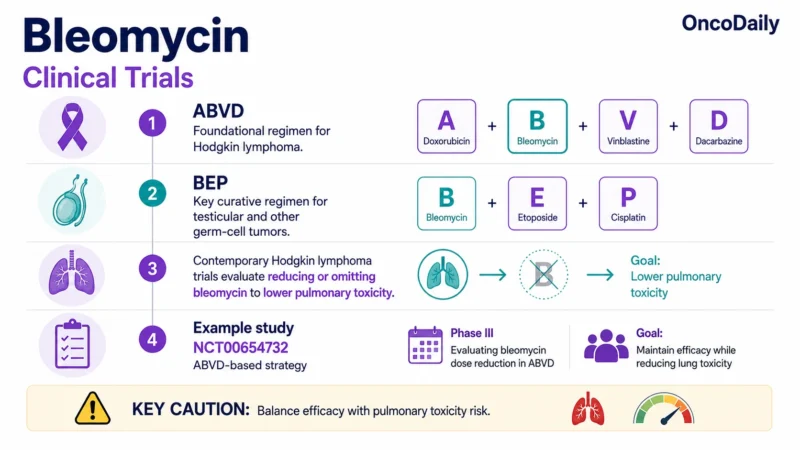
Bleomycin is one of the four drugs in ABVD:
- Doxorubicin
- Bleomycin
- Vinblastine
- Dacarbazine.
ABVD has been a foundational chemotherapy regimen for Hodgkin lymphoma for decades.
Modern Hodgkin lymphoma research has increasingly evaluated whether bleomycin can be reduced or omitted in selected patients to decrease pulmonary toxicity while maintaining disease control.
Testicular Germ-Cell Tumors — BEP
Bleomycin is also a defining component of BEP:
- Bleomycin
- Etoposide
- Cisplatin.
NCI identifies BEP as an established regimen for malignant testicular and ovarian germ-cell tumors.
The curative efficacy of cisplatin-based treatment has made BEP one of the most important historical regimens in germ-cell oncology.
Contemporary Hodgkin Lymphoma Studies
ClinicalTrials.gov includes studies evaluating bleomycin-containing ABVD and modifications of this backbone. For example, NCT00654732 evaluated ABVD-based chemotherapy strategies in Hodgkin lymphoma.
Additional trials continue to explore combinations or modifications intended to retain disease control while reducing cumulative toxicity.
Is Bleomycin FDA Approved?
Yes.
Bleomycin is FDA approved for several malignancies, including:
- Hodgkin lymphoma
- Non-Hodgkin lymphoma
- Testicular carcinoma
- Selected squamous cell carcinomas
It is also approved as a sclerosing agent for malignant pleural effusion.
What Is the Current Role of Bleomycin?
Bleomycin remains an important component of selected curative chemotherapy regimens, particularly:
- ABVD in Hodgkin lymphoma
- BEP in testicular and other germ-cell tumors.
Its use has become increasingly risk-adapted because of concern about potentially irreversible pulmonary toxicity. In some disease settings, modern strategies investigate reducing bleomycin exposure when adequate disease control can be maintained.
Read more: Explore current treatment strategies for poor-risk testicular cancer on OncoDaily.
What Are the Side Effects of Bleomycin?
Important adverse effects include:
- Fever and chills
- Skin hyperpigmentation
- Rash
- Mucositis
- Alopecia
- Nail changes
- Pulmonary pneumonitis
- Pulmonary fibrosis
- Hypersensitivity or idiosyncratic reactions
- Hypotension
- Rare severe systemic reactions.
Pulmonary Toxicity
Pulmonary injury is the most important potentially life-threatening toxicity of bleomycin.
The most common presentation is pneumonitis, which may progress to pulmonary fibrosis. The boxed warning emphasizes the increased risk with higher cumulative doses, particularly above approximately 400 units.
New respiratory symptoms such as cough or dyspnea require prompt clinical evaluation.
Fever and Chills
Fever and chills may occur after bleomycin administration. In lymphoma patients, a rare severe idiosyncratic reaction involving hypotension, confusion, fever, chills, and wheezing has been reported.
Skin Toxicity
Bleomycin is particularly associated with mucocutaneous effects, including skin pigmentation changes, rash, thickening, and other dermatologic reactions.
Myelosuppression
Compared with many other cytotoxic agents, bleomycin produces relatively limited myelosuppression, which makes it suitable for combination with marrow-suppressive chemotherapy.
Written by Mirna Antabian, MD