













Busulfan: An Established Alkylating Agent for Stem-Cell Transplant Conditioning
Key takeaways
- Busulfan is a DNA-alkylating chemotherapy that forms DNA cross-links and inhibits DNA replication and transcription.
- Intravenous busulfan is most commonly used as part of a conditioning regimen before stem-cell transplantation.
- The FDA-labeled adult Busulfex regimen is 0.8 mg/kg IV over 2 hours every 6 hours for 4 days, for a total of 16 doses.
- Anticonvulsant prophylaxis should begin before high-dose IV busulfan because clinically significant seizures can occur.
- Busulfan exposure varies considerably between patients, so pharmacokinetic monitoring and dose adjustment may be used to reach a protocol-defined target exposure.
- Excessive systemic exposure increases the risk of hepatic sinusoidal obstruction syndrome and other toxicities, while inadequate exposure may increase the risk of graft failure or disease relapse.
- Profound and prolonged myelosuppression is expected at transplant-conditioning doses, making hematopoietic progenitor-cell infusion essential.
- Oral busulfan remains FDA approved for palliative CML treatment, but it has largely been replaced in modern CML management by targeted therapies.
Busulfan is an alkylating chemotherapy used primarily as part of conditioning regimens before hematopoietic stem-cell transplantation. Intravenous busulfan, marketed as Busulfex and available in generic formulations, is FDA approved with cyclophosphamide before allogeneic hematopoietic progenitor-cell transplantation in patients with chronic myelogenous leukemia. Oral busulfan, marketed as Myleran, is approved for the palliative treatment of chronic myelogenous leukemia.
This article aims to review busulfan’s mechanism of action, dose, administration, preparation requirements, pharmacokinetics, clinical role, safety profile, approval status, and current use in oncology and stem-cell transplantation.
Busulfan Key Facts
- Generic name: Busulfan
- Brand names: Busulfex, Myleran
- Drug class: Bifunctional alkylating agent; alkyl sulfonate
- Administration: Intravenous infusion or oral tablets
- Primary current use: Conditioning before hematopoietic stem-cell transplantation
- FDA-labeled IV regimen: 0.8 mg/kg IV every 6 hours for 16 doses
- FDA-labeled oral indication: Palliative treatment of chronic myelogenous leukemia
- Required IV premedication: Anticonvulsant prophylaxis and scheduled antiemetics
- Therapeutic drug monitoring: Frequently used in transplant practice
- Important toxicities: Profound myelosuppression, seizures, hepatic sinusoidal obstruction syndrome, mucositis, pulmonary toxicity, infertility, and secondary malignancies
- Approval status: FDA approved
What Is Busulfan?
Busulfan is a synthetic alkylating agent chemically classified as an alkyl sulfonate. Unlike cyclophosphamide and ifosfamide, it is not a nitrogen-mustard derivative and does not require metabolic activation to become cytotoxic.
Busulfan is used in two clinically distinct settings:
- High-dose intravenous busulfan: Used in conditioning regimens before allogeneic or autologous stem-cell transplantation.
- Oral busulfan: FDA approved as palliative treatment for chronic myelogenous leukemia.
The FDA-approved Busulfex indication is specifically busulfan with cyclophosphamide before allogeneic hematopoietic progenitor-cell transplantation for CML. However, transplant centers also use busulfan in protocol-based conditioning regimens for acute leukemias, myelodysplastic syndromes, lymphomas, myeloma, myeloproliferative neoplasms, and selected nonmalignant disorders.
Busulfan Mechanism of Action
Busulfan is a bifunctional alkylating agent that reacts with nucleophilic sites within DNA.
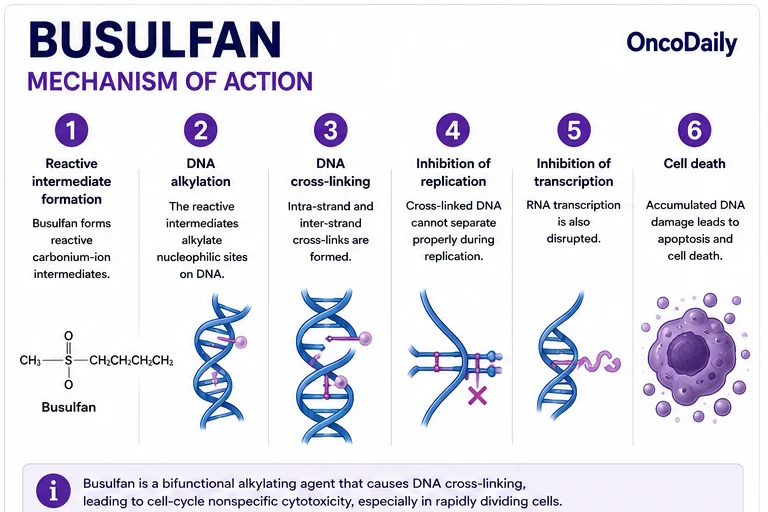
Its mechanism involves several steps:
- Reactive intermediate formation: Busulfan generates reactive carbonium-ion intermediates.
- DNA alkylation: These intermediates attach alkyl groups to DNA.
- DNA cross-linking: Busulfan creates intra-strand and inter-strand DNA cross-links.
- Replication inhibition: Cross-linked DNA cannot separate normally during replication.
- Transcription disruption: RNA transcription is also impaired.
- Cell death: Accumulated DNA damage leads to apoptosis and destruction of hematopoietic and malignant cells.
Busulfan is considered cell-cycle nonspecific, although rapidly dividing hematopoietic cells are particularly susceptible.
Why Is Busulfan Used Before Stem-Cell Transplantation?
High-dose busulfan has both myeloablative and antitumor effects. It eliminates much of the patient’s existing bone marrow, suppresses malignant hematopoietic cells, and creates space for donor or autologous stem cells.
Because the recommended conditioning dose causes profound and prolonged marrow suppression, stem-cell transplantation is required to restore blood-cell production and prevent potentially fatal complications.
What Is the Dose of Busulfan?
Busulfan dosing depends on the formulation, patient age, body size, conditioning regimen, transplantation type, and pharmacokinetic target.
FDA-Labeled Intravenous Dose
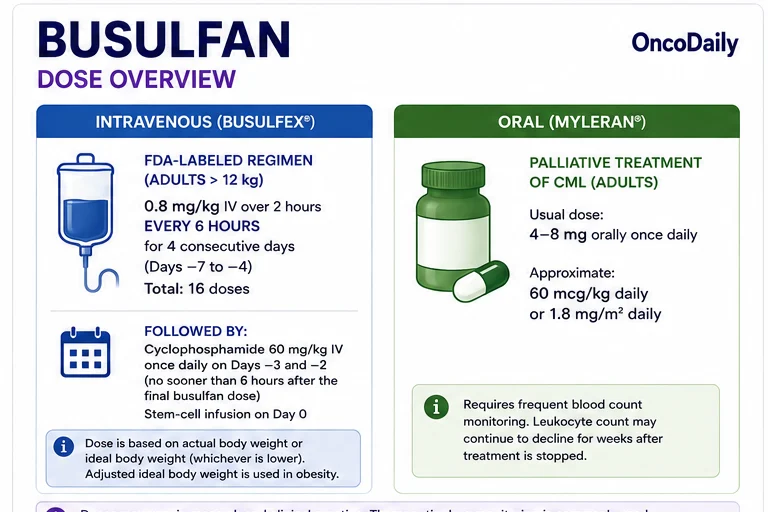
For patients weighing more than 12 kg, the FDA-labeled Busulfex dose is:
Busulfan 0.8 mg/kg intravenously over 2 hours every 6 hours for 4 consecutive days, for a total of 16 doses.
The doses are administered on days −7 through −4 before transplantation.
Cyclophosphamide is then administered at:
60 mg/kg IV once daily on days −3 and −2, beginning no sooner than 6 hours after the final busulfan dose.
Hematopoietic progenitor cells are infused on day 0.
Weight Used for IV Busulfan
The labeled adult dose is based on:
- Actual body weight or ideal body weight, whichever is lower
- Adjusted ideal body weight in patients with obesity
The Busulfex label provides the following adjusted-weight formula:
Adjusted ideal body weight = ideal body weight + 0.25 × (actual weight − ideal body weight).
Weight selection is important because busulfan clearance can differ substantially between lean, normal-weight, and obese patients.
Once-Daily and Pharmacokinetically Targeted Regimens
Many transplant protocols use once-daily IV busulfan rather than the labeled every-6-hour schedule. Common research and clinical regimens administer busulfan over 3 hours once daily for 4 days, with subsequent doses adjusted to achieve a protocol-defined cumulative exposure.
These schedules are protocol-specific and should not be assumed to be interchangeable with the FDA-labeled regimen.
Oral Busulfan Dose
The Myleran label describes a usual adult remission-induction range of approximately:
4–8 mg orally once daily.
Weight-based dosing is approximately:
60 micrograms/kg daily, or about 1.8 mg/m² daily.
Oral dosing requires frequent blood-count monitoring because the leukocyte count may continue declining for weeks after treatment is stopped.
Oral busulfan dosing for CML should be regarded as a historical palliative approach rather than a preferred modern first-line strategy.
How Is Busulfan Administered?
Intravenous Administration
Busulfex is administered through a central venous catheter as a controlled intravenous infusion.
The labeled administration instructions specify:
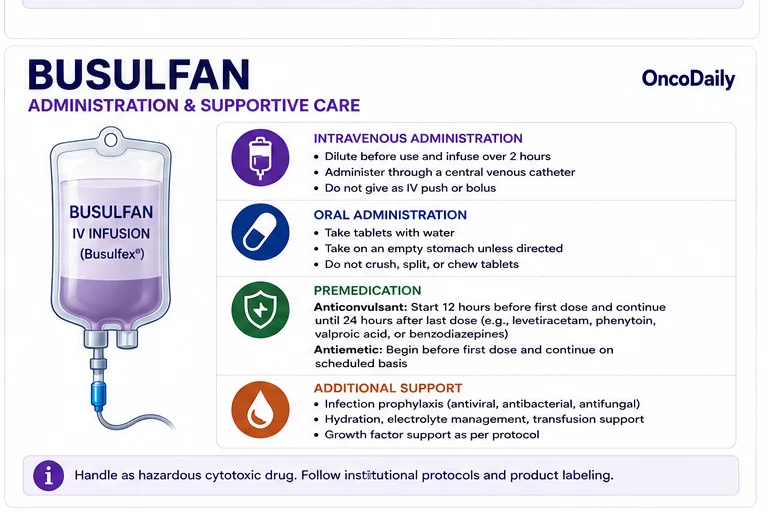
- Dilute before administration
- Administer over 2 hours
- Do not administer by IV push or bolus
- Use a central venous catheter
- Follow the conditioning schedule exactly
Oral Administration
Myleran is supplied as 2-mg film-coated tablets.
Oral busulfan should be administered according to the exact treatment schedule, with close monitoring of:
- Complete blood counts
- Platelet counts
- Symptoms of infection
- Pulmonary symptoms
- Liver function
- Signs of excessive marrow suppression
Oral and intravenous busulfan are not interchangeable milligram-for-milligram because oral absorption and systemic exposure are more variable.
How Is Intravenous Busulfan Prepared?
Busulfex is supplied as:
60 mg in 10 mL, corresponding to 6 mg/mL, in a single-dose vial.
Preparation must follow the product-specific prescribing information and transplant pharmacy protocol. Important principles include:
- Busulfan must be diluted before infusion.
- The calculated busulfan dose should be added to a compatible diluent.
- The final solution must be thoroughly mixed.
- Preparation and administration times must respect the product’s stability limits.
- Busulfan should be handled as a hazardous cytotoxic drug.
- Infusion bags, syringes, and tubing should be prepared according to institutional transplant-pharmacy procedures.
Because different generic formulations may have different labeling or stability instructions, preparation guidance from one manufacturer should not automatically be applied to another.
Does Busulfan Require an In-Line Filter?
The Busulfex label does not establish a universal routine in-line-filter requirement.
Administration should follow:
- The specific busulfan product label
- The transplant-center pharmacy manual
- The infusion set and tubing requirements
- Institutional hazardous-drug policies
The prepared solution should be inspected visually for particulate matter and discoloration before administration.
Is Premedication Required?
Yes. High-dose intravenous busulfan requires specific supportive medication.
Anticonvulsant Prophylaxis
Patients should receive an anticonvulsant beginning:
12 hours before the first busulfan dose and continuing until 24 hours after the final busulfan dose.
The label lists possible agents including:
- Benzodiazepines
- Phenytoin
- Valproic acid
- Levetiracetam
Levetiracetam is frequently used in contemporary transplant practice because it has fewer drug-interaction concerns than phenytoin, although the exact anticonvulsant should follow the transplant protocol.
Antiemetic Prophylaxis
Antiemetics should be given before the first busulfan dose and continued on a scheduled basis throughout busulfan administration.
The regimen may include:
- A 5-HT3 receptor antagonist
- Dexamethasone when appropriate
- An NK1 receptor antagonist
- Olanzapine
- Protocol-defined rescue medication
Infection and Transplant Support
Conditioning regimens commonly require:
- Antiviral prophylaxis
- Antibacterial prophylaxis
- Antifungal prophylaxis
- Blood-product support
- Growth-factor support when specified
- Frequent laboratory monitoring
- Stem-cell infusion after conditioning
Are Dose Reductions Used?
Yes. Busulfan doses may be individualized before or during conditioning.
Dose modification may be based on:
- Pharmacokinetic exposure
- Age
- Body weight
- Obesity
- Organ function
- Previous chemotherapy or transplantation
- Conditioning intensity
- Toxicity
- Protocol-defined target AUC
Once profound marrow suppression has begun, busulfan cannot simply be “reversed.” Therefore, dose calculation, therapeutic drug monitoring, and supportive care are critical.
Therapeutic Drug Monitoring
A blood sample may be collected after an early dose to calculate busulfan exposure.
The result may be expressed as:
- Area under the concentration–time curve
- Average steady-state concentration
- Cumulative AUC across all planned doses
Subsequent doses may then be increased or decreased to reach the protocol-defined target.
The Busulfex label notes that an AUC above approximately 1,500 micromole·min/L per dose may be associated with a higher risk of hepatic veno-occlusive disease in the every-6-hour regimen.
What Is Known About Busulfan Pharmacokinetics?
Busulfan is a small, highly lipophilic molecule that crosses the blood–brain barrier.
The oral label reports that approximately:
- 32% is bound to plasma proteins
- 47% is associated with red blood cells
Busulfan is extensively eliminated through metabolism, and a substantial proportion of radiolabeled material is recovered in urine as methanesulfonic acid and other metabolites.
Busulfan metabolism primarily involves conjugation with glutathione. Variability in glutathione-related metabolism contributes to major differences in clearance and exposure between patients.
Important causes of pharmacokinetic variability include:
- Age
- Body composition
- Liver function
- Obesity
- Drug interactions
- Timing of doses
- Formulation
- Genetic and metabolic differences
This variability is why therapeutic drug monitoring is widely incorporated into transplant protocols.
Are Renal or Hepatic Dose Adjustments Required?
Renal Impairment
No universal creatinine-clearance-based adjustment is established in the Busulfex label.
Busulfan is predominantly eliminated through metabolism rather than unchanged renal excretion. However, renal dysfunction may still influence:
- Overall transplant eligibility
- Concomitant conditioning drugs
- Fluid management
- Electrolytes
- Supportive treatment
- Risk of treatment-related complications
Dose selection should follow the transplant protocol and pharmacokinetic monitoring plan.
Hepatic Impairment
No single validated hepatic dose-adjustment table applies to all busulfan regimens.
Liver function is clinically important because excessive busulfan exposure is associated with hepatic sinusoidal obstruction syndrome, previously called hepatic veno-occlusive disease.
Patients at increased risk may include those with:
- Previous transplantation
- Extensive prior chemotherapy
- Prior radiation
- Pre-existing liver disease
- High busulfan exposure
- Hepatotoxic combination treatment
What Did Busulfan Clinical Studies Show?
FDA-Supporting Busulfex Conditioning Study
In the Busulfex allogeneic-transplantation study, patients received:
- Busulfan 0.8 mg/kg IV every 6 hours for 16 doses
- Cyclophosphamide 60 mg/kg daily for 2 days
- Allogeneic hematopoietic progenitor-cell transplantation
The regimen produced the expected profound myelosuppression. All patients developed severe marrow suppression, and neutrophil recovery occurred after transplantation, generally with growth-factor support.
Busulfan Plus Cyclophosphamide Versus Busulfan Plus Fludarabine
The randomized NCT00774280 study compared once-daily IV busulfan plus cyclophosphamide with busulfan plus fludarabine before allogeneic transplantation in patients with leukemia or myelodysplastic syndrome.
The study reflects the broader shift toward fludarabine–busulfan conditioning, which may reduce selected toxicities compared with cyclophosphamide-based conditioning while preserving myeloablative activity.
Read more: Treosulfan With Fludarabine Compared With Busulfan-Based Conditioning Before Allogeneic Stem-Cell Transplantation on OncoDaily.
Watch more: Professor Nandita Khera discusses advances and remaining gaps in hematopoietic cell transplantation in Improving Outcomes in Transplantation: Addressing Critical Gaps on OncoDaily TV.
Precision Dosing in Children
The NCT04822532 study evaluates personalized initial busulfan dosing in children and adolescents undergoing stem-cell transplantation.
The goal is to improve the accuracy of first-dose selection and reduce the risk of underexposure or excessive toxicity.
Busulfan, Fludarabine and Clofarabine
The NCT01471444 study evaluated IV busulfan with fludarabine and clofarabine before allogeneic transplantation. Busulfan doses were pharmacokinetically adjusted to achieve a protocol-defined systemic exposure.
Busulfan in Autologous Transplantation
Busulfan has also been studied as part of autologous conditioning regimens, including busulfan–melphalan and busulfan-containing regimens for myeloma, lymphoma, neuroblastoma, and Ewing sarcoma.
Is Busulfan Approved?
Yes. Busulfan is FDA approved.
Busulfex
Busulfex is approved:
In combination with cyclophosphamide as a conditioning regimen before allogeneic hematopoietic progenitor-cell transplantation for chronic myelogenous leukemia.
Myleran
Myleran is approved:
For the palliative treatment of chronic myelogenous leukemia.
The FDA-approved indications are narrower than the range of busulfan-containing conditioning regimens used in modern transplantation practice.
What Is the Current Role of Busulfan?
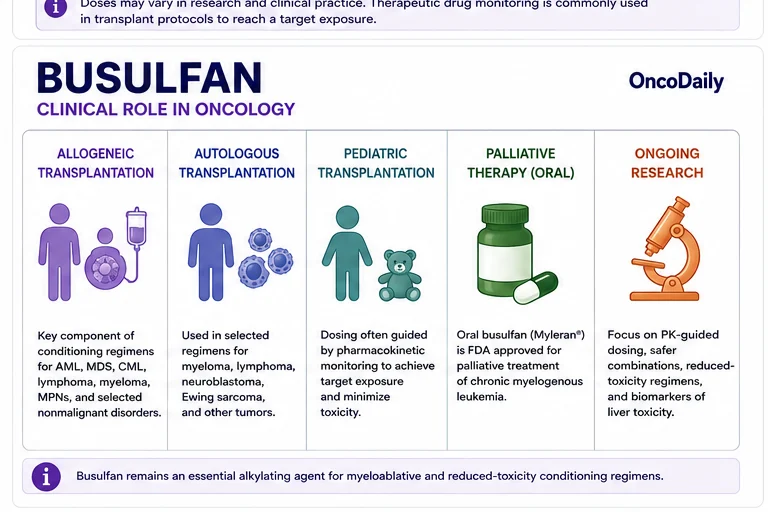
Busulfan remains an established component of both myeloablative and reduced-toxicity conditioning regimens.
Its principal current roles include:
- Allogeneic transplantation for acute myeloid leukemia
- Allogeneic transplantation for myelodysplastic syndromes
- Transplantation for CML and other myeloproliferative disorders
- Conditioning for selected lymphomas and myeloma
- Pediatric transplantation
- Conditioning for selected nonmalignant hematologic diseases
- Autologous conditioning in selected tumor types
Modern development focuses less on busulfan as a new drug and more on:
- Pharmacokinetically guided dosing
- Safer conditioning combinations
- Reduced-toxicity regimens
- Pediatric dose prediction
- Biomarkers of hepatic toxicity
- Improved prevention of sinusoidal obstruction syndrome
What Are the Side Effects of Busulfan?
Common or clinically important adverse effects include:
- Profound neutropenia
- Thrombocytopenia
- Anemia
- Infection
- Fever
- Nausea
- Vomiting
- Diarrhea
- Oral mucositis
- Reduced appetite
- Fatigue
- Elevated liver enzymes
- Hyperbilirubinemia
- Electrolyte abnormalities
- Infertility
- Hair thinning or hair loss
Severe Myelosuppression
Profound and prolonged marrow suppression occurs at conditioning doses.
The Busulfex label states that severe myelosuppression occurred in all patients in the supporting clinical trial. Daily complete blood counts should be monitored until engraftment is established.
Seizures
High-dose busulfan can cross the blood–brain barrier and may cause seizures.
Anticonvulsant prophylaxis is therefore required before and during IV conditioning. Patients with a history of seizures, head trauma, or exposure to other seizure-promoting drugs require particular caution.
Hepatic Sinusoidal Obstruction Syndrome
Busulfan can damage hepatic sinusoidal endothelial cells, leading to:
- Weight gain
- Fluid retention
- Painful hepatomegaly
- Rising bilirubin
- Ascites
- Liver dysfunction
- Multiorgan failure in severe cases
Higher systemic exposure and extensive prior treatment increase the risk.
Pulmonary Toxicity
Long-term oral busulfan exposure has been associated with interstitial pulmonary fibrosis, sometimes called “busulfan lung.”
Symptoms may include:
- Progressive cough
- Shortness of breath
- Reduced diffusion capacity
- Fever
- Pulmonary infiltrates
The oral label describes onset ranging from months to years after treatment initiation.
Infertility
Busulfan is highly gonadotoxic and may cause:
- Ovarian failure
- Amenorrhea
- Failure of pubertal development
- Reduced sperm production
- Azoospermia
- Testicular atrophy
- Permanent infertility
Secondary Malignancies
Busulfan is mutagenic and carcinogenic. Long-term exposure has been associated with acute leukemia, myelodysplastic changes, and other secondary malignancies.
Written by Mirna Antabian, MD