













Cytarabine: Mechanism of Action, Dose, Administration, Clinical Uses, and Side Effects
Key takeaways
- Cytarabine is one of the cornerstone chemotherapy drugs in AML treatment.
- It is converted intracellularly to cytarabine triphosphate (ara-CTP), which inhibits DNA polymerase and interferes with DNA synthesis.
- Standard AML induction commonly uses 100 mg/m²/day for 7 days, typically with an anthracycline as part of the traditional “7+3” regimen.
- Higher-dose cytarabine is frequently used during AML consolidation and in selected salvage regimens.
- Cytarabine may be administered IV, subcutaneously, or intrathecally; it is not effective orally because of rapid metabolism and poor oral absorption.
- Only preservative-free cytarabine should be used intrathecally.
- High-dose therapy requires close monitoring for cerebellar neurotoxicity and corneal toxicity.
- Cytarabine remains integral to modern AML regimens despite the increasing use of targeted and molecularly directed therapies.
Cytarabine, also called cytosine arabinoside or Ara-C, is an antimetabolite chemotherapy used mainly in hematologic malignancies, particularly acute myeloid leukemia (AML). It may be administered intravenously, subcutaneously, or intrathecally, depending on the indication and regimen. Cytarabine is FDA approved for remission induction in acute non-lymphocytic leukemia and for prevention and treatment of meningeal leukemia.
This article aims to review cytarabine mechanism of action, dose, administration, clinical-trial findings, pharmacokinetics, safety profile, and current role in oncology.
Cytarabine Key Facts
- Generic name: Cytarabine
- Other names: Ara-C, cytosine arabinoside
- Drug class: Pyrimidine antimetabolite; nucleoside analog
- Primary role: Acute myeloid leukemia
- Administration: Intravenous infusion or injection, subcutaneous injection, or intrathecal administration
- Standard AML induction dose: 100 mg/m²/day by continuous IV infusion on Days 1–7, or 100 mg/m² IV every 12 hours on Days 1–7
- High-dose cytarabine: Commonly 1–3 g/m² per dose in protocol-defined consolidation or salvage regimens
- Intrathecal use: Preservative-free formulation only
- Approval status: FDA approved
- Major toxicities: Myelosuppression, infection, mucositis, nausea, hepatic dysfunction, and at high doses, cerebellar and ocular toxicity.
What Is Cytarabine?
Cytarabine is a cytidine nucleoside analog that interferes with DNA synthesis in rapidly dividing cells.
Its chemical structure contains an arabinose sugar rather than the ribose sugar found in normal cytidine. After entering malignant cells, cytarabine is phosphorylated to its active triphosphate metabolite, ara-CTP.
Cytarabine is used most prominently in:
- Acute myeloid leukemia
- Selected acute lymphoblastic leukemia regimens
- Blast-phase chronic myeloid leukemia
- CNS or meningeal leukemia
- Selected lymphoma and hematopoietic-transplant regimens.
Cytarabine Mechanism of Action
Cytarabine is primarily an S-phase-specific antimetabolite.
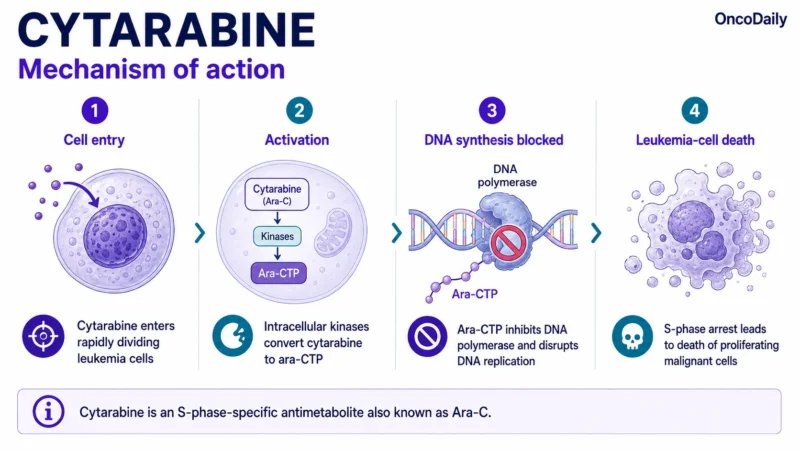
Its mechanism involves:
- Cytarabine enters malignant cells.
- Intracellular kinases convert it to ara-CTP.
- Ara-CTP competes with normal cytidine nucleotides.
- It interferes with incorporation of nucleotides into DNA.
- It inhibits DNA polymerase.
- DNA replication and repair are disrupted.
- Rapidly proliferating leukemia cells undergo cell death.
Cellular sensitivity depends partly on the balance between enzymes that activate cytarabine and cytidine deaminase, which converts cytarabine to an inactive metabolite.
What Is the Dose of Cytarabine?
Cytarabine dosing varies substantially according to disease, treatment phase, patient age, and combination regimen.
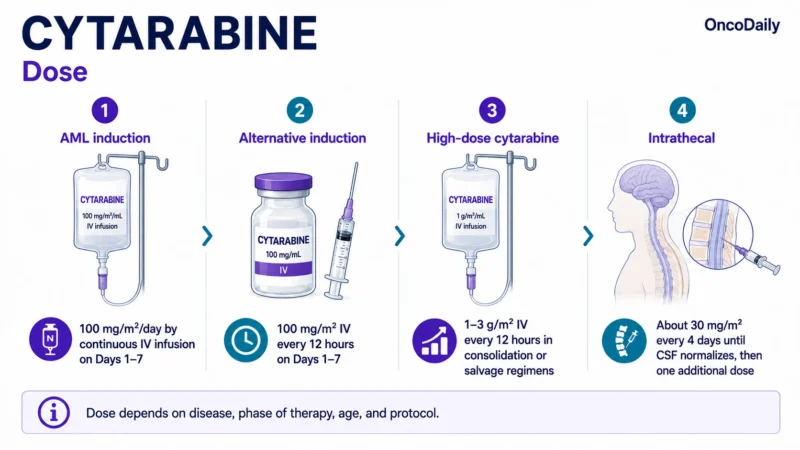
AML Induction
A standard labeled schedule is:
100 mg/m²/day by continuous IV infusion on Days 1–7
or
100 mg/m² IV every 12 hours on Days 1–7.
In modern AML treatment, cytarabine is frequently paired with an anthracycline as part of the classic 7+3 induction regimen.
High-Dose Cytarabine
High-dose cytarabine, often abbreviated HiDAC, is commonly used in consolidation or selected salvage settings.
Protocol-defined doses frequently range around:
1–3 g/m² IV every 12 hours for a specified number of doses.
These schedules are substantially more intensive than standard-dose cytarabine and require enhanced monitoring for neurologic and ocular toxicity.
Intrathecal Cytarabine
For meningeal leukemia, labeled intrathecal doses have ranged from:
5–75 mg/m².
The most frequently reported dose in the label is:
30 mg/m² intrathecally every 4 days until cerebrospinal fluid findings normalize, followed by one additional treatment.
Intrathecal regimens remain protocol-specific.
How Is Cytarabine Administered?
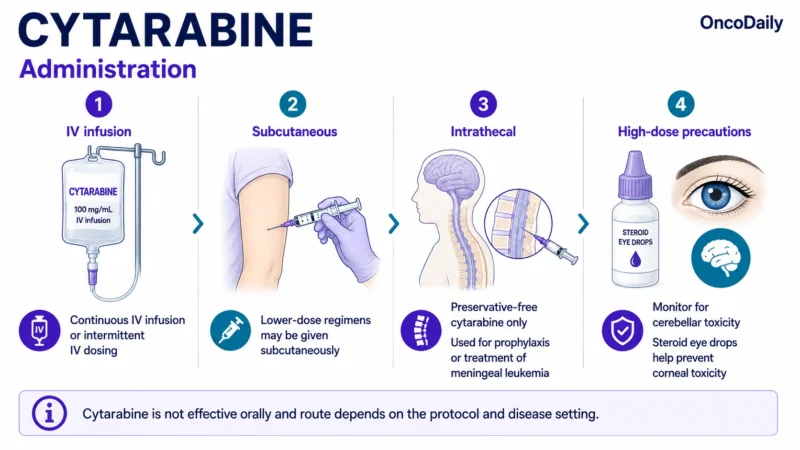
Cytarabine may be given by:
- Continuous intravenous infusion
- IV injection
- Subcutaneous injection
- Intrathecal administration.
It is not effective orally, because less than 20% of an oral dose is absorbed and the drug is rapidly metabolized.
Intravenous Administration
Cytarabine may be administered as a continuous infusion or intermittent IV doses depending on the treatment protocol.
For conventional AML induction, continuous infusion over 7 days is commonly used.
Subcutaneous Administration
Lower-dose cytarabine regimens may be given subcutaneously, particularly in selected patients with AML who are not receiving intensive induction therapy.
Intrathecal Administration
Only a preservative-free formulation should be used for intrathecal administration.
Concurrent intrathecal and systemic cytarabine within a short interval may increase the risk of spinal-cord toxicity and requires careful protocol-specific management.
Does Cytarabine Require an In-Line Filter?
There is no universal cytarabine-specific in-line filter requirement across all IV formulations and treatment protocols.
Preparation and administration should follow:
- The specific product label
- Institutional chemotherapy procedures
- Protocol-defined dilution and infusion requirements
- Instructions for other drugs administered concurrently.
Cytarabine is chemically compatible with commonly used infusion solutions including 0.9% sodium chloride and 5% dextrose, according to product stability data.
Is Premedication Required?
Routine conventional-dose cytarabine does not require one universal premedication regimen.
However, high-dose cytarabine commonly requires prophylactic corticosteroid eye drops because of the risk of corneal toxicity and hemorrhagic conjunctivitis.
Other supportive measures may include:
- Antiemetics
- Antimicrobial prophylaxis according to neutropenia risk
- Tumor-lysis monitoring
- Blood-product support
- Hydration according to the overall treatment protocol.
Are Dose Reductions Used?
Yes.
Treatment may be delayed, reduced, or discontinued because of:
- Prolonged myelosuppression
- Severe infection
- Hepatic dysfunction
- Renal dysfunction
- Cerebellar toxicity
- Peripheral neuropathy
- Severe gastrointestinal toxicity
- Pulmonary toxicity.
The label recommends considering suspension or modification when marrow suppression produces platelets below 50,000/mm³ or polymorphonuclear granulocytes below 1,000/mm³, while recognizing that blood counts may continue falling after cytarabine is stopped.
High-dose regimens frequently use additional age-, renal-function-, and toxicity-based modifications.
What Is Known About Cytarabine Pharmacokinetics?
Cytarabine is rapidly metabolized.
After IV administration:
- Plasma disappearance is biphasic.
- The initial distribution half-life is approximately 10 minutes.
- The later elimination half-life is approximately 1–3 hours.
- Cytarabine is converted largely to the inactive metabolite ara-U.
- Approximately 80% of administered radioactivity can be recovered in urine within 24 hours, predominantly as ara-U.
Continuous IV infusion can maintain relatively stable plasma concentrations.
Cytarabine penetrates the cerebrospinal fluid poorly after a single systemic dose, which is why direct intrathecal administration may be used for meningeal leukemia.
Are Renal or Hepatic Dose Adjustments Required?
There is no single universally applicable renal- or hepatic-adjustment schedule across all cytarabine regimens.
However, high-dose cytarabine requires particular caution in patients with impaired renal or hepatic function because these patients may have an increased risk of neurologic toxicity.
Treatment decisions are generally based on:
- Renal function
- Hepatic function
- Patient age
- Previous neurotoxicity
- Treatment intensity
- Protocol-specific criteria.
What Did Cytarabine Clinical Trials Show?
AML Induction — The 7+3 Backbone
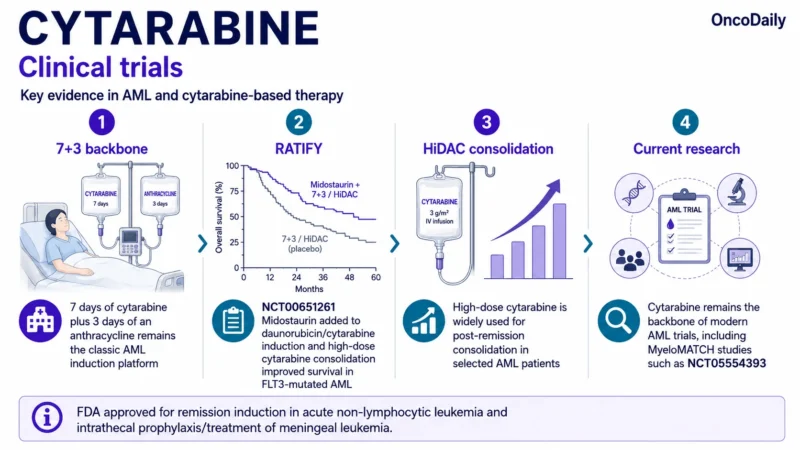
Cytarabine combined with an anthracycline became the historical backbone of intensive AML induction therapy.
The conventional approach uses approximately:
7 days of continuous cytarabine plus 3 days of an anthracycline.
Although many modern AML trials add targeted agents to this backbone, cytarabine remains one of its essential components.
RATIFY — FLT3-Mutated AML
The Phase 3 RATIFY trial (NCT00651261) evaluated midostaurin versus placebo added to daunorubicin and cytarabine induction and high-dose cytarabine consolidation in patients with FLT3-mutated AML.
The trial demonstrated that adding midostaurin improved survival and helped establish targeted therapy combined with a cytarabine-containing backbone for FLT3-mutated AML.
High-Dose Cytarabine Consolidation
High-dose cytarabine has long been used as consolidation therapy after remission, particularly in selected patients with favorable-risk AML.
The balance between dose intensity and toxicity remains important, especially because neurologic toxicity increases with high-dose exposure.
Modern Cytarabine-Based AML Trials
Contemporary studies continue to evaluate different cytarabine-containing combinations. For example, NCT05554393 is a MyeloMATCH study comparing cytarabine-containing approaches in intermediate-risk AML.
Cytarabine also remains a comparator or backbone in trials involving targeted agents, antibody-drug conjugates, and liposomal chemotherapy.
Is Cytarabine FDA Approved?
Yes.
Cytarabine is FDA approved:
- In combination with other anticancer drugs for remission induction in acute non-lymphocytic leukemia in adults and children.
- For prophylaxis and treatment of meningeal leukemia when administered intrathecally.
It is also widely used within protocol-based therapy for AML and selected other hematologic malignancies.
What Is the Current Role of Cytarabine?
Cytarabine remains one of the most important chemotherapy agents in hematologic oncology.
Its major roles include:
- AML induction
- AML consolidation
- Selected AML salvage regimens
- Selected ALL protocols
- Blast-phase CML
- CNS leukemia prophylaxis and treatment
- Selected lymphoma regimens
- Hematopoietic stem-cell transplant conditioning regimens.
Modern targeted therapies have changed AML treatment substantially, but many intensive regimens still rely on cytarabine as the chemotherapy backbone.
Read more: Acute Myeloid Leukemia (AML) in 2026 on OncoDaily.
Watch more: Explore how cytarabine-based chemotherapy fits into the evolving AML treatment landscape in Emerging Therapies in Acute Myeloid Leukemia.
What Are the Side Effects of Cytarabine?
Important adverse effects include:
- Myelosuppression
- Neutropenia
- Thrombocytopenia
- Anemia
- Infection
- Fever
- Nausea and vomiting
- Diarrhea
- Mucositis
- Hepatic dysfunction
- Rash
- Conjunctivitis
- Cerebellar toxicity
- Peripheral neuropathy
- Pulmonary toxicity.
Myelosuppression
Bone-marrow suppression is the principal dose-limiting toxicity of cytarabine. Severe neutropenia and thrombocytopenia can lead to serious infections and bleeding.
Cerebellar Toxicity
High-dose cytarabine may cause:
- Ataxia
- Dysarthria
- Nystagmus
- Somnolence
- Confusion
- Other cerebellar or cerebral dysfunction.
Neurologic assessment is therefore particularly important during high-dose treatment.
Ocular Toxicity
High-dose cytarabine can cause corneal toxicity and hemorrhagic conjunctivitis. Corticosteroid eye-drop prophylaxis can reduce this risk.
Cytarabine Syndrome
A characteristic inflammatory syndrome may develop after cytarabine administration and can include fever, myalgia, bone pain, rash, conjunctivitis, and malaise.
Written by Mirna Antabian, MD