













Doxorubicin: Mechanism of Action, Dose, Administration, Clinical Uses, and Side Effects
Key takeaways
- Doxorubicin is one of the most widely established anthracycline chemotherapies and remains an important component of curative and palliative cancer regimens.
- It works through DNA intercalation, topoisomerase II inhibition, and generation of reactive oxygen species.
- Conventional doxorubicin is given intravenously, commonly at 60–75 mg/m² every 21 days as monotherapy or 40–75 mg/m² in combination regimens.
- Doxorubicin-containing regimens include AC for breast cancer, R-CHOP for lymphoma, ABVD for Hodgkin lymphoma, and anthracycline-based therapy for sarcoma.
- Cardiomyopathy is cumulative-dose related, with substantially greater concern as lifetime exposure increases; the label notes increased risk above a cumulative dose of 550 mg/m².
- Doxorubicin is a vesicant, and extravasation can cause severe local tissue necrosis.
- Hepatic impairment requires dose reduction because doxorubicin clearance depends substantially on hepatobiliary elimination.
- Conventional doxorubicin should not be confused with pegylated liposomal doxorubicin, which has different pharmacokinetics, dosing, indications, and toxicity.
Doxorubicin is an anthracycline chemotherapy used across a broad range of hematologic and solid malignancies, including breast cancer, lymphomas, leukemias, sarcomas, and several pediatric cancers. Conventional doxorubicin is administered intravenously, either alone or as part of multidrug regimens such as AC, R-CHOP, ABVD, and anthracycline-based sarcoma therapy. It has been FDA approved since 1974.
This article aims to review doxorubicin mechanism of action, dose, administration, clinical-trial findings, pharmacokinetics, safety profile, and current role in cancer treatment.
Doxorubicin Key Facts
- Generic name: Doxorubicin hydrochloride
- Common brand/trade name: Adriamycin
- Drug class: Anthracycline antineoplastic antibiotic
- Administration: Intravenous injection or infusion
- Single-agent dose: 60–75 mg/m² IV every 21 days
- Combination-treatment dose: 40–75 mg/m² IV every 21–28 days
- Adjuvant breast cancer dose: 60 mg/m² IV on Day 1 every 21 days with cyclophosphamide for 4 cycles
- Major concern: Cumulative cardiotoxicity
- Important administration risk: Severe tissue injury from extravasation
- Approval status: FDA approved
- Major toxicities: Myelosuppression, cardiomyopathy, alopecia, nausea, mucositis, secondary malignancies, and tissue necrosis after extravasation.
What Is Doxorubicin?
Doxorubicin is an anthracycline antineoplastic antibiotic that damages DNA and interferes with topoisomerase II activity in rapidly proliferating cancer cells.
The FDA label includes indications in:
- Breast cancer
- Acute lymphoblastic leukemia
- Acute myeloid leukemia
- Hodgkin lymphoma
- Non-Hodgkin lymphoma
- Wilms tumor
- Neuroblastoma
- Soft-tissue sarcoma
- Bone sarcoma
- Ovarian cancer
- Bladder cancer
- Thyroid cancer
- Gastric cancer
- Bronchogenic carcinoma.
Doxorubicin has remained clinically important for decades because of its broad antitumor activity and its ability to combine effectively with other cytotoxic agents.
Doxorubicin Mechanism of Action
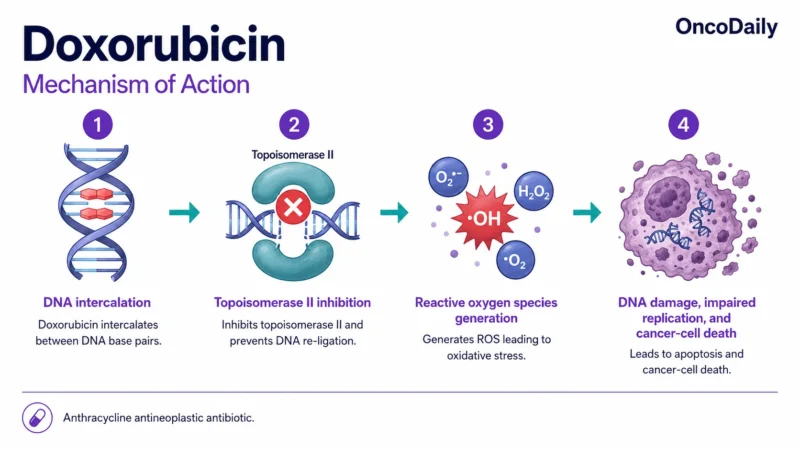
Doxorubicin produces anticancer effects through several complementary mechanisms:
- Doxorubicin enters the cancer cell.
- It intercalates between DNA base pairs.
- It inhibits topoisomerase II, stabilizing DNA-topoisomerase complexes after DNA strand cleavage.
- DNA strands cannot be properly re-ligated.
- DNA replication and transcription are disrupted.
- Doxorubicin also generates reactive oxygen species.
- Oxidative and genomic damage ultimately contribute to cancer-cell death.
Reactive oxygen species are also thought to contribute to some anthracycline toxicities, particularly cardiac injury.
What Is the Dose of Doxorubicin?
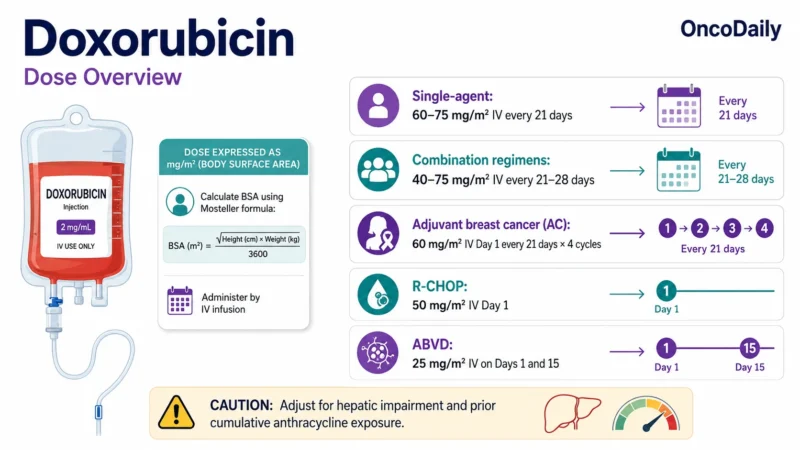
Doxorubicin dosing varies according to cancer type, combination regimen, prior treatment, hepatic function, and cumulative anthracycline exposure.
Single-Agent Doxorubicin
The FDA-labeled dose is:
60–75 mg/m² IV every 21 days.
Combination Chemotherapy
When used with other chemotherapy drugs:
40–75 mg/m² IV every 21–28 days is the labeled range.
Adjuvant Breast Cancer
A labeled AC regimen uses:
Doxorubicin 60 mg/m² IV on Day 1 every 21 days
combined with cyclophosphamide for 4 cycles.
R-CHOP for Lymphoma
A commonly used R-CHOP regimen includes:
Doxorubicin 50 mg/m² IV on Day 1
with rituximab, cyclophosphamide, vincristine, and prednisone, generally according to a 21-day protocol.
ABVD for Hodgkin Lymphoma
ABVD commonly includes:
Doxorubicin 25 mg/m² IV on Days 1 and 15
along with bleomycin, vinblastine, and dacarbazine.
These regimen-specific doses should not be considered interchangeable.
Watch more: Explore doxorubicin’s mechanism of action and role in cancer treatment in Medicine of the Week: Doxorubicin.
How Is Doxorubicin Administered?
Conventional doxorubicin is administered intravenously.
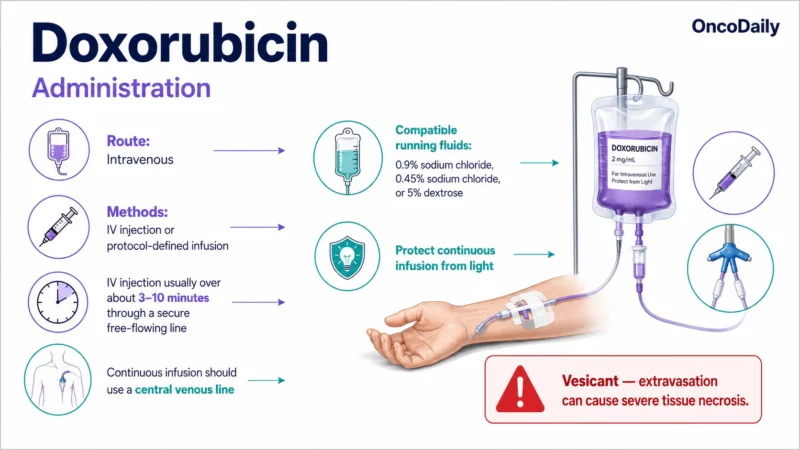
The label describes administration either as:
- IV injection
- Continuous IV infusion.
For IV injection, the reconstituted and diluted drug is administered through a secure, free-flowing IV line, generally over approximately 3–10 minutes.
Compatible running fluids listed in the label include:
- 0.9% sodium chloride
- 0.45% sodium chloride
- 5% dextrose.
Continuous infusion should be administered through a central venous line, and the solution should be protected from light during infusion.
Why Is Extravasation Important With Doxorubicin?
Doxorubicin is a vesicant.
If the drug leaks outside the vein, it can cause:
- Severe pain
- Local inflammation
- Blistering
- Ulceration
- Progressive tissue necrosis.
If extravasation is suspected, administration should be stopped immediately and managed according to anthracycline-extravasation protocols.
Does Doxorubicin Require an In-Line Filter?
There is no universal conventional-doxorubicin in-line filter requirement across all formulations and administration methods.
Administration should follow:
- The specific product label
- Pharmacy preparation procedures
- Institutional vesicant-administration policy
- Requirements of the complete chemotherapy regimen.
This should not be confused with liposomal doxorubicin products, which have formulation-specific administration instructions.
Is Premedication Required?
Doxorubicin does not require one universal drug-specific premedication regimen.
However, it is usually given as part of chemotherapy combinations with clinically significant emetogenic potential, so patients frequently receive antiemetic prophylaxis such as:
- A 5-HT3 antagonist
- Dexamethasone
- An NK1 antagonist
- Other agents according to the complete regimen and patient risk.
Premedication therefore depends primarily on the overall chemotherapy regimen, rather than doxorubicin alone.
Are Dose Reductions Used?
Yes.
Doxorubicin may require dose reduction, treatment delay, or discontinuation because of:
- Hepatic impairment
- Severe myelosuppression
- Cardiac dysfunction
- Previous anthracycline exposure
- Significant nonhematologic toxicity
- Advanced age or extensive previous treatment.
The label specifically recommends considering lower doses or longer intervals for heavily pretreated, elderly, or obese patients.
Why Is Cumulative Doxorubicin Dose Important?
Doxorubicin can cause dose-dependent cardiomyopathy.
The probability of cardiac injury increases with cumulative anthracycline exposure. The current label notes that cumulative doses above 550 mg/m² are associated with an increased risk of cardiomyopathy.
Risk may occur at lower cumulative doses when other cardiac risk factors are present, including:
- Previous mediastinal radiation
- Other cardiotoxic drugs
- Pre-existing cardiovascular disease
- Older age.
Cardiac function is therefore commonly assessed before treatment and monitored during therapy when clinically appropriate.
Read more: Explore doxorubicin and other anthracyclines, including their mechanisms and cardiotoxicity, in Red Devil Chemotherapy on OncoDaily.
What Is Known About Doxorubicin Pharmacokinetics?
After IV administration, doxorubicin undergoes rapid tissue distribution and extensive hepatic metabolism.
Important characteristics include:
- Extensive tissue distribution
- Metabolism primarily in the liver
- Formation of active and inactive metabolites, including doxorubicinol
- Predominantly biliary elimination
- Relatively slow terminal elimination from tissues.
Because hepatic function significantly influences clearance, bilirubin elevation can increase systemic exposure and toxicity.
Are Renal or Hepatic Dose Adjustments Required?
Hepatic Impairment
Yes.
Doxorubicin exposure increases when hepatic clearance is impaired, and the FDA label recommends dose reduction according to serum bilirubin. Severe hepatic impairment is a contraindication.
Renal Impairment
There is no standard universal renal-dose reduction comparable with the established hepatic adjustment scheme.
Clinical judgment should consider:
- Overall renal function
- Other chemotherapy agents
- Treatment-related toxicity
- Comorbidities.
What Did Doxorubicin Clinical Trials Show?
Breast Cancer — Anthracycline-Based Chemotherapy
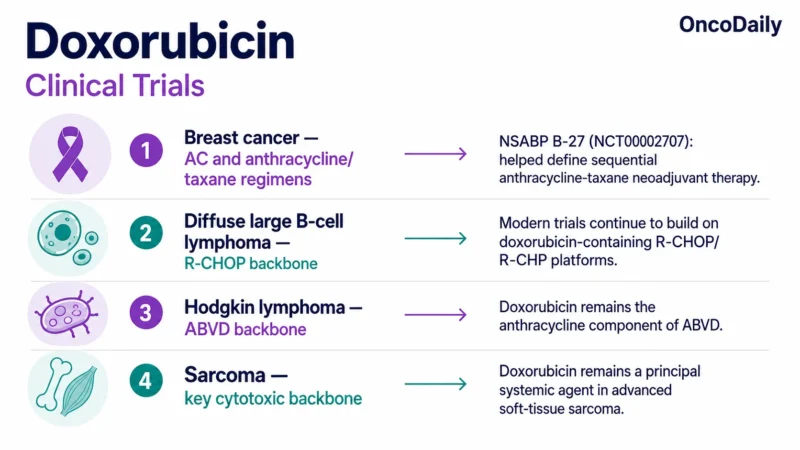
Doxorubicin became a major component of adjuvant and neoadjuvant breast-cancer chemotherapy through regimens such as AC and AC followed by a taxane.
The Phase 3 NSABP B-27 trial (NCT00002707) enrolled more than 2,400 women with operable breast cancer and evaluated preoperative doxorubicin/cyclophosphamide with different approaches to adding docetaxel.
The study helped define the role of sequential anthracycline- and taxane-containing neoadjuvant therapy.
Non-Hodgkin Lymphoma — R-CHOP
Doxorubicin is one of the core drugs in R-CHOP:
- Rituximab
- Cyclophosphamide
- Doxorubicin
- Vincristine
- Prednisone.
R-CHOP became a standard first-line regimen for diffuse large B-cell lymphoma and continues to serve as a backbone or comparator in modern clinical trials. Current studies continue to evaluate novel agents added to or substituted within doxorubicin-containing R-CHOP/R-CHP platforms.
Hodgkin Lymphoma — ABVD
Doxorubicin is also the anthracycline component of ABVD, historically one of the principal chemotherapy backbones for classical Hodgkin lymphoma.
Modern Hodgkin lymphoma trials increasingly evaluate whether targeted agents can improve or modify this anthracycline-containing treatment backbone.
Sarcoma
Doxorubicin remains one of the principal systemic cytotoxic agents for advanced soft-tissue sarcoma and is commonly used alone or in anthracycline-containing combinations.
Is Doxorubicin FDA Approved?
Yes.
Conventional doxorubicin has been FDA approved since 1974 and has indications across multiple hematologic and solid cancers.
It is important to distinguish conventional doxorubicin from pegylated liposomal doxorubicin, because the formulations are not interchangeable and have different dosing, pharmacokinetic, and toxicity profiles.
What Is the Current Role of Doxorubicin?
Doxorubicin remains a major chemotherapy backbone in:
- Breast cancer — AC and anthracycline/taxane regimens
- Diffuse large B-cell lymphoma — R-CHOP/R-CHP platforms
- Hodgkin lymphoma — ABVD and related strategies
- Soft-tissue and bone sarcomas
- Selected leukemias
- Pediatric solid tumors
- Other anthracycline-sensitive cancers.
NCI continues to list numerous active clinical trials incorporating doxorubicin, demonstrating its continuing role as a backbone for studies of newer targeted and immune-based treatments.
What Are the Side Effects of Doxorubicin?
Important adverse effects include:
- Myelosuppression
- Neutropenia
- Anemia
- Thrombocytopenia
- Nausea and vomiting
- Mucositis
- Alopecia
- Fatigue
- Cardiotoxicity
- Arrhythmias
- Hepatic toxicity
- Secondary malignancies
- Severe tissue damage after extravasation
- Red-orange discoloration of urine after treatment.
Cardiotoxicity
Cardiomyopathy is one of the most clinically important doxorubicin toxicities.
Cardiac injury can occur during treatment or emerge months to years afterward. Risk increases as cumulative anthracycline exposure rises.
Myelosuppression
Doxorubicin may cause severe bone-marrow suppression, resulting in serious infection, sepsis, transfusion requirements, hospitalization, or death.
Extravasation
Doxorubicin extravasation can produce progressive tissue necrosis, making careful IV-line assessment essential throughout administration.
Secondary Malignancies
Therapy-related acute myeloid leukemia or myelodysplastic syndromes may occur after anthracycline-containing chemotherapy, particularly when used with other DNA-damaging agents.
Written by Mirna Antabian, MD