













Epirubicin: Mechanism of Action, Dose, Administration, Clinical Uses, and Side Effects
Key takeaways
- Epirubicin is an anthracycline closely related to doxorubicin; chemically, it is the 4-epimer of doxorubicin.
- It acts through DNA intercalation, topoisomerase II–mediated DNA damage, inhibition of DNA helicase, and generation of cytotoxic free radicals.
- The FDA-labeled starting dose is 100–120 mg/m² IV, administered in repeated 3- to 4-week cycles.
- Epirubicin is intravenous only and is typically administered into a freely flowing IV line over approximately 15–20 minutes at labeled starting doses.
- The drug is a vesicant; extravasation may cause severe tissue injury and necrosis.
- Cardiotoxicity is related to cumulative exposure; the label reports increasing cardiomyopathy rates at cumulative doses of 550, 700, and 900 mg/m², and generally recommends avoiding cumulative exposure of 900 mg/m².
- Hepatic dysfunction requires defined dose reductions, while lower doses should be considered in severe renal impairment.
- Epirubicin remains an established component of FEC chemotherapy, which combines fluorouracil, epirubicin, and cyclophosphamide.
Epirubicin is an anthracycline chemotherapy and topoisomerase inhibitor used most prominently in breast cancer, particularly as part of combination regimens such as FEC or other anthracycline-based chemotherapy. In the United States, epirubicin hydrochloride is FDA approved as a component of adjuvant therapy after surgery for breast cancer with axillary lymph-node involvement and is administered intravenously.
This article aims to review epirubicin mechanism of action, dose, administration, clinical-trial findings, pharmacokinetics, safety profile, and current role in cancer treatment.
Epirubicin Key Facts
- Generic name: Epirubicin hydrochloride
- Brand name: Ellence
- Drug class: Anthracycline cytotoxic agent; topoisomerase inhibitor
- Administration: Intravenous only
- FDA-approved oncology use: Adjuvant treatment of node-positive breast cancer after resection
- Recommended labeled dose: 100–120 mg/m² IV per treatment cycle
- FEC-100 dose: 100 mg/m² IV on Day 1 every 21 days for 6 cycles
- CEF-120 epirubicin component: 60 mg/m² IV on Days 1 and 8 every 28 days for 6 cycles
- Major concern: Cumulative cardiotoxicity
- Important administration risk: Severe tissue necrosis following extravasation
- Major toxicities: Myelosuppression, infection, nausea, mucositis, alopecia, cardiotoxicity, and secondary malignancies.
What Is Epirubicin?
Epirubicin is a semisynthetic anthracycline chemotherapy that interferes with DNA replication and transcription in rapidly proliferating cancer cells.
Chemically, epirubicin is the 4-epimer of doxorubicin and a semisynthetic derivative of daunorubicin. Its structural difference from doxorubicin alters its pharmacologic properties while retaining anthracycline antitumor activity.
In the United States, Ellence is specifically indicated as part of adjuvant chemotherapy in patients with axillary node-positive breast cancer following resection of the primary tumor.
Epirubicin may be incorporated into multidrug chemotherapy, including FEC, consisting of fluorouracil, epirubicin, and cyclophosphamide.
Epirubicin Mechanism of Action
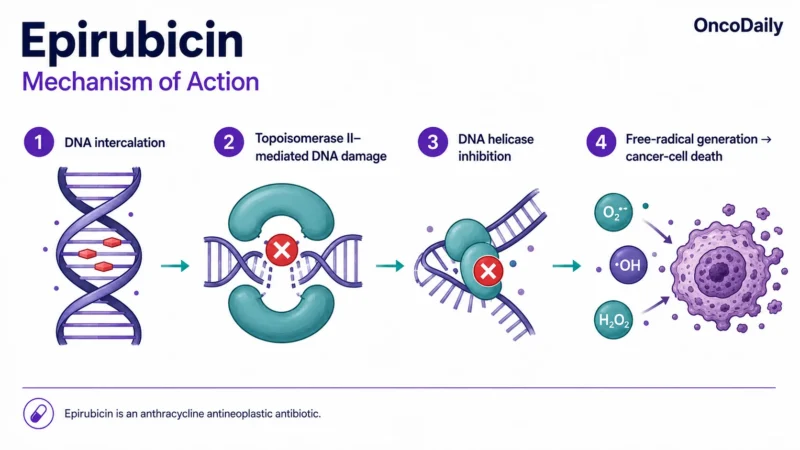
Epirubicin damages cancer cells through several complementary mechanisms.
- Epirubicin enters the cancer cell.
- Its planar anthracycline rings intercalate between DNA base pairs.
- DNA intercalation interferes with DNA, RNA, and protein synthesis.
- Epirubicin promotes topoisomerase II–mediated DNA cleavage.
- It also inhibits DNA helicase, interfering with DNA strand separation.
- Oxidation-reduction reactions generate cytotoxic free radicals.
- Accumulation of DNA and cellular damage ultimately suppresses proliferation and promotes cancer-cell death.
The FDA label notes that the complete cytotoxic mechanism is likely multifactorial rather than attributable to one pathway alone.
Watch more: Learn about epirubicin’s mechanism of action, clinical uses, dosing, and adverse effects in Epirubicin | Uses, Dosage, Side Effects & Mechanism.
What Is the Dose of Epirubicin?
The FDA-recommended starting dose of epirubicin is:
100–120 mg/m² intravenously per treatment cycle.
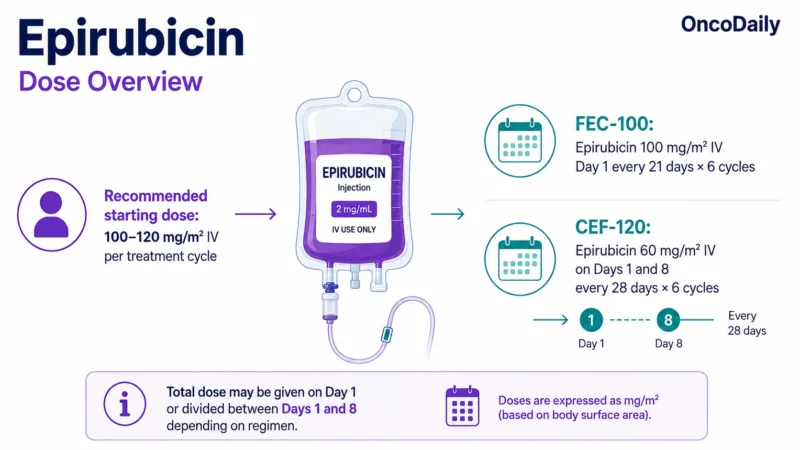
Treatment is administered in repeated 3- to 4-week cycles, either as the total dose on Day 1 or divided between Days 1 and 8 according to the regimen.
FEC-100 Regimen
The FDA label describes:
- Fluorouracil 500 mg/m² IV on Day 1
- Epirubicin 100 mg/m² IV on Day 1
- Cyclophosphamide 500 mg/m² IV on Day 1
- Repeated every 21 days for 6 cycles.
CEF-120 Regimen
The labeled regimen contains:
- Cyclophosphamide 75 mg/m² orally on Days 1–14
- Epirubicin 60 mg/m² IV on Days 1 and 8
- Fluorouracil 500 mg/m² IV on Days 1 and 8
- Repeated every 28 days for 6 cycles.
The total epirubicin exposure per course is therefore 120 mg/m².
Patients receiving the 120 mg/m² regimen should receive prophylactic antibiotic therapy, according to the current FDA label.
How Is Epirubicin Administered?
Epirubicin is administered intravenously only.
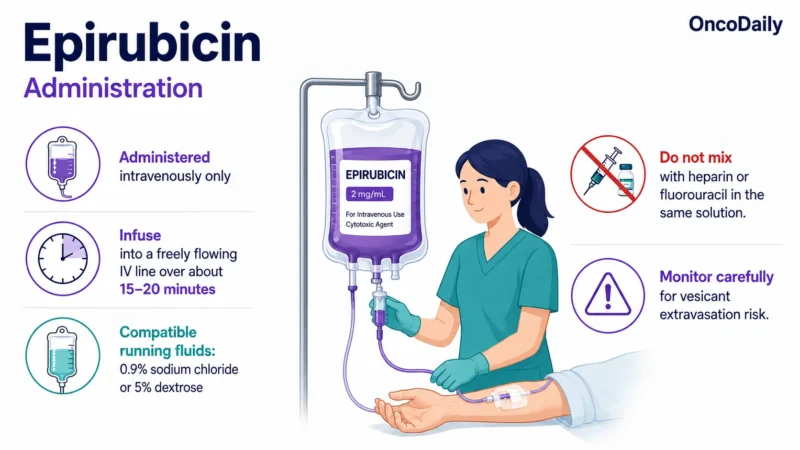
At the recommended starting doses of 100–120 mg/m², the label recommends administration into the tubing of a freely flowing IV infusion over approximately 15–20 minutes.
The running infusion may contain:
- 0.9% sodium chloride, or
- 5% glucose/dextrose solution.
The venous line should be monitored carefully because epirubicin is a potent vesicant.
Epirubicin should not be mixed with heparin or fluorouracil in the same solution, because chemical incompatibility may cause precipitation.
Why Is Extravasation Important With Epirubicin?
Epirubicin extravasation can produce severe local tissue injury and necrosis.
If infiltration is suspected, administration should be discontinued immediately. The FDA label recommends intermittent application of ice to the affected area and management according to appropriate extravasation procedures.
Potential complications include:
- Pain and burning
- Local inflammation
- Ulceration
- Progressive tissue necrosis
- Need for surgical excision or skin grafting.
Does Epirubicin Require an In-Line Filter?
The current Ellence prescribing information does not specify a universal in-line filter requirement for conventional epirubicin administration.
The drug should instead be administered according to the product label and institutional chemotherapy procedures, using a freely flowing IV infusion.
Is Premedication Required?
There is no universal epirubicin-specific hypersensitivity premedication regimen.
However, the FDA label recommends considering antiemetic therapy before administration or when clinically indicated, particularly when epirubicin is combined with other emetogenic drugs.
For the 120 mg/m² regimen, prophylactic antibiotics are recommended.
Other supportive care depends on the complete chemotherapy regimen and individual patient risk.
Are Dose Reductions Used?
Yes.
Epirubicin dosing may need to be reduced or delayed because of:
- Myelosuppression
- Severe nonhematologic toxicity
- Hepatic impairment
- Severe renal impairment
- Previous chemotherapy exposure
- Cardiac toxicity or high cumulative anthracycline exposure.
Dose adjustment after the first cycle is based on hematologic and nonhematologic toxicity.
Why Is Cumulative Epirubicin Dose Important?
Cardiotoxicity is one of the most important cumulative toxicities of epirubicin.
The FDA label reports cardiomyopathy incidences of approximately:
- 0.9% at 550 mg/m²
- 1.6% at 700 mg/m²
- 3.3% at 900 mg/m² cumulative epirubicin exposure.
Because cardiac risk continues to rise with cumulative exposure, total doses of 900 mg/m² should generally be avoided.
Risk is greater when epirubicin is combined with or follows other cardiotoxic therapies. The label recommends assessing left ventricular ejection fraction before treatment and regularly during and after therapy.
Read more: Explore epirubicin and other anthracyclines, including their mechanisms and cardiotoxicity, in Red Devil Chemotherapy on OncoDaily.
What Is Known About Epirubicin Pharmacokinetics?
Following IV administration, epirubicin distributes rapidly and extensively into tissues.
Its plasma concentrations decline in three phases, with approximate mean half-lives of:
- 3 minutes
- 2.5 hours
- 33 hours for the terminal phase.
Approximately 77% is plasma-protein bound, predominantly to albumin.
Epirubicin undergoes extensive hepatic metabolism, including formation of epirubicinol, which has substantially weaker cytotoxic activity than the parent drug.
The drug and its metabolites are eliminated predominantly through biliary excretion, with a smaller contribution from urinary elimination.
Are Renal or Hepatic Dose Adjustments Required?
Hepatic Impairment
Yes.
The FDA label recommends:
Bilirubin 1.2–3 mg/dL or AST 2–4× ULN:
→ 50% of the recommended starting dose
Bilirubin >3 mg/dL or AST >4× ULN:
→ 25% of the recommended starting dose.
Because epirubicin depends heavily on hepatic metabolism and biliary elimination, liver dysfunction can substantially reduce clearance and increase toxicity.
Renal Impairment
For serum creatinine >5 mg/dL, lower doses should be considered. Patients receiving dialysis have not been adequately studied.
No significant pharmacokinetic alteration was observed in patients with serum creatinine below 5 mg/dL.
What Did Epirubicin Clinical Trials Show?
MA-5 — CEF-120 in Node-Positive Breast Cancer
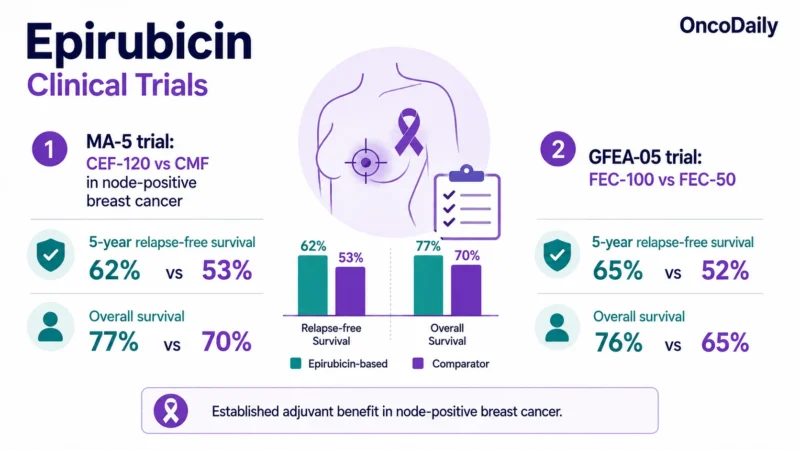
The pivotal MA-5 study randomized 716 premenopausal or perimenopausal women with node-positive breast cancer to epirubicin-containing CEF-120 or CMF chemotherapy.
At 5 years:
Relapse-free survival was 62% with CEF-120 vs 53% with CMF
Overall survival was 77% vs 70%
Hazard ratio for relapse was 0.76
Hazard ratio for death was 0.71.
These findings supported the clinical effectiveness of an epirubicin-containing adjuvant regimen in node-positive breast cancer.
GFEA-05 — FEC-100 vs FEC-50
The GFEA-05 study randomized 565 women to higher-dose FEC-100 or lower-dose FEC-50.
At 5 years:
- Relapse-free survival was 65% with FEC-100 vs 52% with FEC-50
- Overall survival was 76% vs 65%
- Hazard ratio for relapse was 0.68
- Hazard ratio for death was 0.69.
The study demonstrated superior outcomes with the higher-dose epirubicin regimen.
Long-Term Follow-Up
Benefits in relapse-free survival remained evident with follow-up extending to approximately 10 years in both pivotal studies, although the magnitude and statistical significance of the overall-survival findings varied between the trials.
Related epirubicin clinical trials: NCT00033683, NCT01222052, and NCT00129935 evaluated epirubicin-containing adjuvant chemotherapy strategies in breast cancer.
Is Epirubicin FDA Approved?
Yes.
Ellence is FDA approved as a component of adjuvant therapy for patients with axillary node-positive breast cancer following resection of the primary breast tumor.
Its U.S. indication is therefore more specific than the broader range of cancers in which anthracyclines may be used internationally or in protocol-based practice.
What Is the Current Role of Epirubicin?
Epirubicin remains an established anthracycline option in breast cancer chemotherapy, particularly in regimens such as FEC, which combines fluorouracil, epirubicin, and cyclophosphamide.
Its use must be balanced against cumulative anthracycline toxicity, particularly cardiac dysfunction and severe myelosuppression.
What Are the Side Effects of Epirubicin?
Important adverse effects include:
- Neutropenia
- Leukopenia
- Thrombocytopenia
- Anemia
- Infection
- Nausea and vomiting
- Mucositis
- Alopecia
- Cardiotoxicity
- Extravasation-related tissue necrosis
- Secondary AML or myelodysplastic syndromes
- Thromboembolic complications
- Radiation-recall reactions.
Myelosuppression
Severe myelosuppression is a major dose-limiting toxicity.
Potential consequences include serious infection, sepsis, septic shock, hemorrhage, transfusion requirements, hospitalization, and death.
Cardiotoxicity
Epirubicin may cause acute or delayed myocardial damage, including reduced ventricular function and congestive heart failure.
Risk increases with cumulative anthracycline exposure, making baseline and longitudinal cardiac assessment important.
Extravasation
Because epirubicin is a vesicant, leakage outside the vein can lead to serious and potentially progressive tissue necrosis.
Secondary Malignancies
Secondary AML and myelodysplastic syndromes have been reported after epirubicin-containing chemotherapy, particularly in patients receiving additional cytotoxic treatments.
Written by Mirna Antabian, MD