













Etoposide: Mechanism of Action, Dose, Administration, Clinical Uses, and Side Effects
Key takeaways
- Etoposide inhibits topoisomerase II, preventing normal re-ligation of cleaved DNA.
- Accumulation of DNA strand breaks interferes with replication and transcription and can trigger apoptosis.
- The drug is particularly active during the S and G2 phases of the cell cycle.
- Etoposide is a central component of platinum-etoposide chemotherapy for SCLC.
- It is also a key component of BEP chemotherapy for germ-cell tumors.
- Conventional IV etoposide should be administered by slow IV infusion, generally over 30–60 minutes, rather than rapid IV injection.
- Myelosuppression, particularly neutropenia, is the major dose-limiting toxicity.
- Modern SCLC trials such as IMpower133 and CASPIAN retained platinum-etoposide as the chemotherapy backbone while adding immune-checkpoint inhibitors.
Etoposide, also known as VP-16, is a semisynthetic podophyllotoxin derivative and topoisomerase II inhibitor used in several important chemotherapy regimens. Its FDA-labeled uses include combination treatment for small cell lung cancer (SCLC) and refractory testicular tumors, while it is also incorporated into multiple lymphoma, leukemia, germ-cell tumor, and other oncology protocols.
This article aims to review etoposide mechanism of action, dose, administration, pharmacokinetics, clinical-trial findings, safety profile, renal dose adjustment, approval status, and current role in oncology.
Etoposide Key Facts
- Generic name: Etoposide
- Common abbreviation: VP-16
- Drug class: Podophyllotoxin derivative; topoisomerase II inhibitor
- Administration: Intravenous; oral formulations also exist
- Main FDA-labeled cancers: Small cell lung cancer and refractory testicular tumors
- Common combination partners: Cisplatin, carboplatin, bleomycin, cyclophosphamide, and other regimen-specific agents
- Major toxicity: Myelosuppression
- Important administration issue: Rapid IV administration can cause hypotension
- Renal adjustment: Reduced initial dosing is recommended when creatinine clearance is 15–50 mL/min
- Approval status: FDA approved.
What Is Etoposide?
Etoposide is a semisynthetic derivative of podophyllotoxin that inhibits DNA topoisomerase II.
Topoisomerase II normally creates temporary DNA breaks to relieve structural tension during DNA replication and transcription and subsequently re-ligates those breaks.
Etoposide stabilizes the topoisomerase II–DNA cleavage complex and interferes with DNA re-ligation. This results in accumulation of DNA strand breaks and ultimately inhibits tumor-cell proliferation.
FDA-labeled uses include:
- Small cell lung cancer, in combination with other approved agents as first-line treatment
- Refractory testicular tumors, in combination with other approved chemotherapy agents after prior appropriate treatment.
Beyond these labeled indications, etoposide is incorporated into numerous established combination regimens across hematologic malignancies and solid tumors.
Etoposide Mechanism of Action
Etoposide primarily targets topoisomerase II, an enzyme required for normal DNA replication and repair.
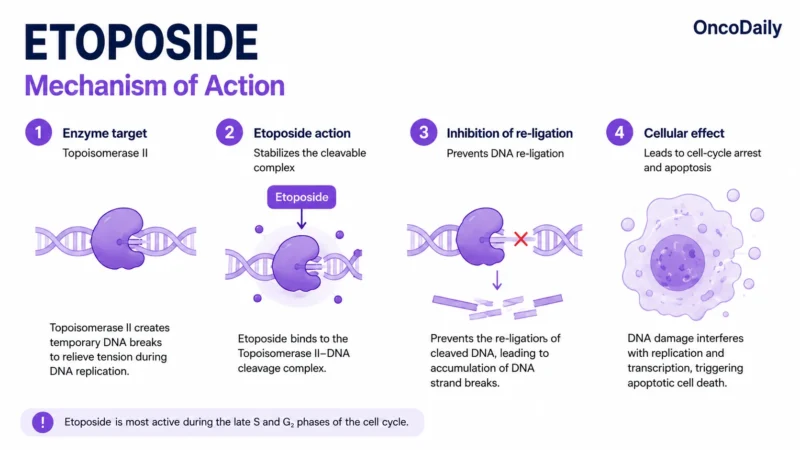
The mechanism can be summarized in four stages:
- Etoposide enters the cancer cell.
- It binds to the topoisomerase II–DNA cleavage complex.
- Etoposide prevents efficient re-ligation of cleaved DNA, causing accumulation of DNA strand breaks.
- Persistent DNA damage interferes with replication and transcription and promotes cell-cycle arrest and apoptotic cell death.
Etoposide has greatest activity during the late S and G2 phases of the cell cycle.
What Is the Dose of Etoposide?
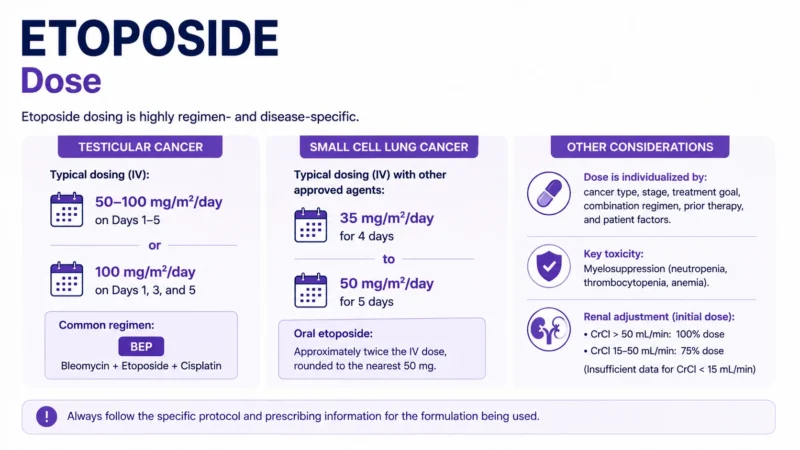
Etoposide dosing is highly regimen- and disease-specific.
Testicular Cancer
According to the current prescribing information, etoposide injection in combination chemotherapy is generally administered within a range of:
50–100 mg/m²/day on Days 1–5
or:
100 mg/m²/day on Days 1, 3, and 5.
One of the best-known uses is the BEP regimen, combining:
- Bleomycin
- Etoposide
- Cisplatin.
The exact dose and number of treatment cycles depend on disease stage, prognostic group, and protocol.
Small Cell Lung Cancer
The FDA label describes IV doses ranging from:
35 mg/m²/day for 4 days
to:
50 mg/m²/day for 5 days
when used with other approved chemotherapy agents.
In contemporary clinical practice, platinum-etoposide schedules may use different etoposide doses depending on the specific protocol, including three-day regimens.
Oral Etoposide
For SCLC, the current label states that the recommended oral dose is approximately twice the IV dose, rounded to the nearest 50 mg.
Because oral bioavailability is variable and regimen specific, oral and IV schedules should not be substituted without following the relevant treatment protocol.
How Is Etoposide Administered?
Conventional etoposide injection is administered as a slow intravenous infusion.
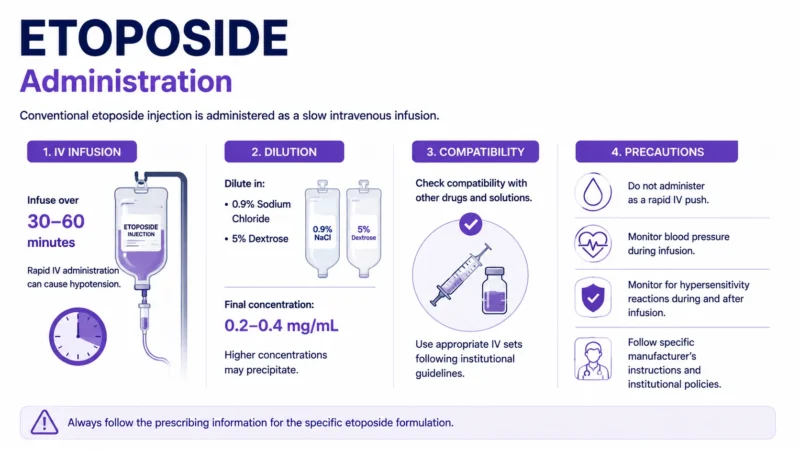
The current prescribing information recommends administering IV etoposide over approximately:
30–60 minutes.
Rapid intravenous injection should be avoided because it can cause transient hypotension.
For one current etoposide injection formulation, the concentrate should be diluted in:
- 0.9% sodium chloride
- or 5% dextrose
to a final concentration of approximately 0.2–0.4 mg/mL. Higher concentrations may precipitate.
Administration instructions can vary by product and formulation, particularly with etoposide phosphate, so the specific prescribing information should always be followed.
Does Etoposide Require an In-Line Filter?
Conventional etoposide prescribing information does not establish a universal drug-specific requirement for an in-line filter.
Administration should therefore follow:
- The specific manufacturer’s instructions
- Institutional chemotherapy policies
- Requirements of the infusion set and formulation.
Compatibility is particularly important because conventional etoposide has limited aqueous solubility and can precipitate when prepared above recommended concentrations.
Is Premedication Required?
Routine corticosteroid or antihistamine premedication is not universally required for conventional etoposide.
However, antiemetic prophylaxis is commonly given according to:
- The full chemotherapy regimen
- The emetogenic risk of accompanying drugs
- Patient-specific factors.
This is particularly relevant when etoposide is combined with highly emetogenic agents such as cisplatin.
Hypersensitivity or anaphylactic-like reactions can occur during infusion, so patients should be monitored appropriately.
Are Dose Reductions Used?
Yes.
Etoposide treatment may be delayed or reduced because of:
- Neutropenia
- Thrombocytopenia
- Renal impairment
- Previous chemotherapy or radiotherapy
- Reduced bone-marrow reserve
- Significant nonhematologic toxicity.
The prescribing information emphasizes that myelosuppression is dose limiting and recommends monitoring blood counts before and during treatment.
What Is Known About Etoposide Pharmacokinetics?
Etoposide disposition involves both renal and nonrenal clearance.
Its total body clearance correlates with:
- Creatinine clearance
- Serum albumin
- Nonrenal clearance.
Renal impairment increases systemic exposure because reduced kidney function decreases etoposide clearance.
Etoposide is also substantially protein bound, making serum albumin clinically relevant to drug exposure.
The drug has both renal and biliary/fecal elimination pathways, while renal function remains one of the most important factors influencing dose selection.
Are Renal or Hepatic Dose Adjustments Required?
Renal Impairment
For conventional etoposide, the current prescribing information recommends the following initial adjustment:
- CrCl >50 mL/min: 100% of the planned dose
- CrCl 15–50 mL/min: 75% of the planned dose
For creatinine clearance below 15 mL/min, adequate data are unavailable and further dose reduction should be considered. Subsequent doses should be guided by tolerance and clinical effect.
Hepatic Impairment
There is no equally simple FDA-label dosing table for hepatic impairment.
Because etoposide is highly protein bound and undergoes nonrenal elimination, liver function, albumin level, and overall toxicity should be considered when selecting treatment.
Institutional or disease-specific protocols should guide dosing in clinically significant hepatic dysfunction.
What Did Etoposide Clinical Trials Show?
Small Cell Lung Cancer
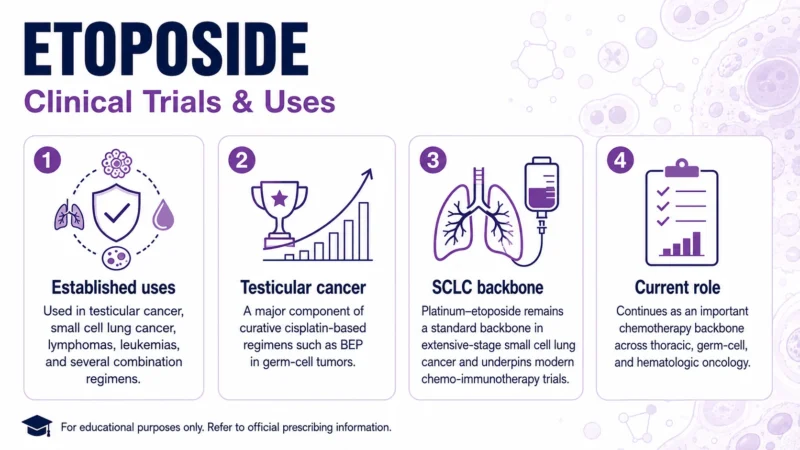
Etoposide combined with platinum chemotherapy became one of the principal systemic-treatment backbones for SCLC.
That role remains highly relevant even in the immunotherapy era because pivotal contemporary trials added immune-checkpoint inhibitors to platinum-etoposide rather than replacing it.
IMpower133
The Phase 3 IMpower133 trial randomized 503 patients with previously untreated extensive-stage SCLC to:
- Atezolizumab + carboplatin + etoposide
- or placebo + carboplatin + etoposide.
The study established carboplatin-etoposide plus atezolizumab as an important first-line approach for extensive-stage SCLC.
CASPIAN
The Phase 3 CASPIAN trial evaluated:
- Durvalumab + platinum-etoposide
- Durvalumab + tremelimumab + platinum-etoposide
- Platinum-etoposide alone.
The study confirmed that adding durvalumab to platinum-etoposide improved outcomes in untreated extensive-stage SCLC and reinforced etoposide as the chemotherapy backbone of modern first-line treatment.
Limited-Stage SCLC
Etoposide plus cisplatin has also been extensively studied with thoracic radiotherapy in limited-stage SCLC.
For example, NCT00066222 evaluated cisplatin and etoposide together with accelerated high-dose thoracic radiotherapy in limited-stage disease.
Testicular and Germ-Cell Tumors
Etoposide is a central component of curative platinum-based chemotherapy for germ-cell tumors, particularly BEP.
The combination of bleomycin, etoposide, and cisplatin became a cornerstone of treatment because germ-cell tumors are among the solid malignancies most sensitive to platinum-based combination chemotherapy.
In contemporary oncology, etoposide remains essential in curative-intent regimens for many patients with advanced testicular germ-cell tumors.
Is Etoposide FDA Approved?
Yes.
The current U.S. prescribing information lists etoposide for:
- Small cell lung cancer, in combination with other approved chemotherapeutic agents as first-line treatment
- Refractory testicular tumors, in combination with other approved agents following previous appropriate treatment.
What Is the Current Role of Etoposide?
Etoposide remains one of the most important established cytotoxic agents in oncology.
Its major contemporary roles include:
- Small cell lung cancer: platinum-etoposide remains a foundational chemotherapy backbone, now commonly combined with immunotherapy in extensive-stage disease.
- Testicular and other germ-cell tumors: etoposide remains a key component of curative regimens such as BEP.
- Lymphomas: etoposide is incorporated into selected multidrug regimens, including etoposide-containing variants used in aggressive lymphomas.
- Hematologic malignancies and transplant protocols: etoposide is used in several disease- and protocol-specific combinations.
- Other solid tumors: it continues to have selected roles in neuroendocrine and other chemotherapy-sensitive malignancies.
Its persistence across modern treatment regimens reflects both its strong antitumor activity and its ability to combine effectively with platinum drugs and newer systemic therapies.
Read more: Explore the role of platinum–etoposide chemotherapy in small cell lung cancer on OncoDaily.
Watch more: Small Cell Lung Cancer Treatment
What Are the Side Effects of Etoposide?
Important adverse effects include:
- Neutropenia
- Leukopenia
- Thrombocytopenia
- Anemia
- Nausea
- Vomiting
- Alopecia
- Mucositis
- Fatigue
- Hypotension with rapid infusion
- Hypersensitivity and anaphylactic-like reactions
- Infection associated with neutropenia
- Secondary acute leukemia in rare cases.
Myelosuppression
Bone-marrow suppression is the major dose-limiting toxicity of etoposide.
Granulocyte nadirs generally occur approximately 7–14 days after treatment, while platelet nadirs typically occur approximately 9–16 days after administration. Bone-marrow recovery is usually evident by around Day 20.
Regular complete blood counts are therefore essential during therapy.
Hypotension
Rapid IV administration can produce transient hypotension.
To reduce this risk, conventional etoposide should generally be administered over 30–60 minutes, with longer infusion times used when clinically necessary.
Hypersensitivity Reactions
Anaphylactic-like reactions may include:
- Chills
- Fever
- Tachycardia
- Bronchospasm
- Dyspnea
- Hypotension.
The infusion should be stopped promptly when a significant reaction occurs and appropriate supportive management initiated.
Secondary Leukemia
Rare cases of therapy-related acute leukemia, sometimes preceded by a myelodysplastic or preleukemic phase, have been associated with etoposide-containing treatment.
Alopecia
Reversible alopecia is common and may occasionally be extensive.