













Fluorouracil (5-FU): Mechanism of Action, Dose, Administration, Clinical Uses, and Side Effects
Key takeaways
- Fluorouracil (5-FU) remains one of the foundational chemotherapy drugs in gastrointestinal oncology.
- It works mainly through inhibition of thymidylate synthase and incorporation of fluorinated metabolites into RNA and DNA.
- Fluorouracil may be administered as an IV bolus or prolonged continuous infusion, depending on the regimen.
- A commonly used colorectal regimen gives 400 mg/m² IV bolus followed by 2,400–3,000 mg/m² over 46 hours every 2 weeks.
- Fluorouracil is frequently combined with leucovorin, oxaliplatin, irinotecan, or other systemic therapies.
- Toxicity patterns differ by schedule: bolus treatment is generally associated with more myelosuppression, while prolonged infusion is particularly associated with mucositis and hand-foot syndrome.
- Severe DPD deficiency can cause profound, potentially fatal fluoropyrimidine toxicity.
- Fluorouracil remains central to regimens such as FOLFOX, FOLFIRI, FOLFIRINOX, and FLOT.
Fluorouracil (5-FU) is a fluoropyrimidine antimetabolite chemotherapy widely used in gastrointestinal, breast, head and neck, and other cancers. In oncology, it is given primarily by intravenous bolus or continuous intravenous infusion, usually as part of multidrug regimens such as FOLFOX, FOLFIRI, FOLFIRINOX, FLOT, or fluorouracil/leucovorin. It is FDA approved for several solid-tumor indications.
This article aims to review fluorouracil (5-FU) mechanism of action, dose, administration, clinical-trial findings, supportive care, safety profile, and current role in cancer treatment.
Fluorouracil (5-FU) Key Facts
- Generic name: Fluorouracil
- Common abbreviation: 5-FU
- Drug class: Fluoropyrimidine antimetabolite
- Main administration: Intravenous bolus or continuous IV infusion
- Major uses: Colorectal, gastric, pancreatic, breast, and selected head and neck cancers
- Common combination: Leucovorin, which enhances fluorouracil’s inhibition of thymidylate synthase
- Typical infusional colorectal regimen: 400 mg/m² IV bolus followed by 2,400–3,000 mg/m² continuous IV infusion over 46 hours every 2 weeks
- Approval status: FDA approved
- Major toxicities: Myelosuppression, mucositis, diarrhea, hand-foot syndrome, cardiotoxicity, and neurotoxicity
- Important biomarker: DPD/DPYD deficiency markedly increases the risk of severe or fatal fluorouracil toxicity.
What Is Fluorouracil (5-FU)?
Fluorouracil is a fluorinated pyrimidine analog and antimetabolite that interferes with DNA and RNA synthesis in rapidly dividing cells.
Its established oncology uses include cancers of the:
- Colon and rectum
- Pancreas
- Stomach
- Breast
- Head and neck.
Fluorouracil is often given with leucovorin, which stabilizes the interaction between one of fluorouracil’s active metabolites and thymidylate synthase, increasing inhibition of DNA synthesis.
Fluorouracil (5-FU) Mechanism of Action
After entering cells, fluorouracil is converted into several active metabolites.
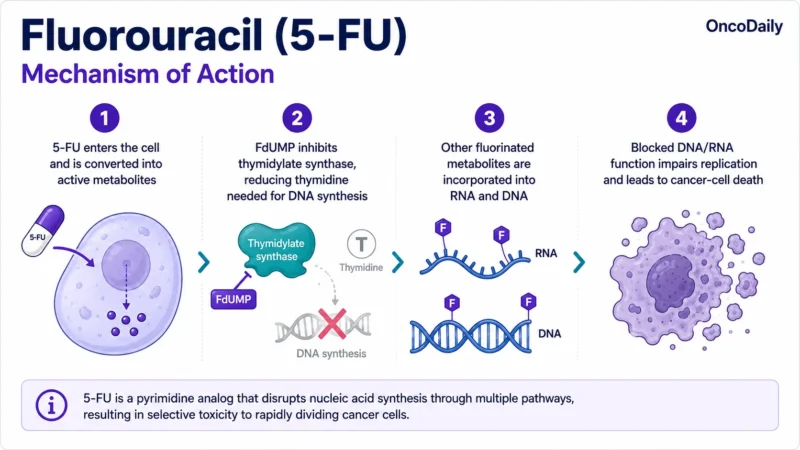
The main antitumor effects involve:
- Formation of FdUMP, an active fluorouracil metabolite.
- Inhibition of thymidylate synthase, which reduces thymidine availability.
- Depletion of nucleotides required for normal DNA synthesis.
- Incorporation of fluorouracil metabolites into RNA, disrupting RNA processing and function.
- Incorporation into DNA, contributing to DNA damage.
- Impaired replication and eventual cancer-cell death.
Leucovorin increases the stability of the FdUMP-thymidylate synthase complex and therefore enhances the cytotoxic effect of fluorouracil.
What Is the Dose of Fluorouracil (5-FU)?
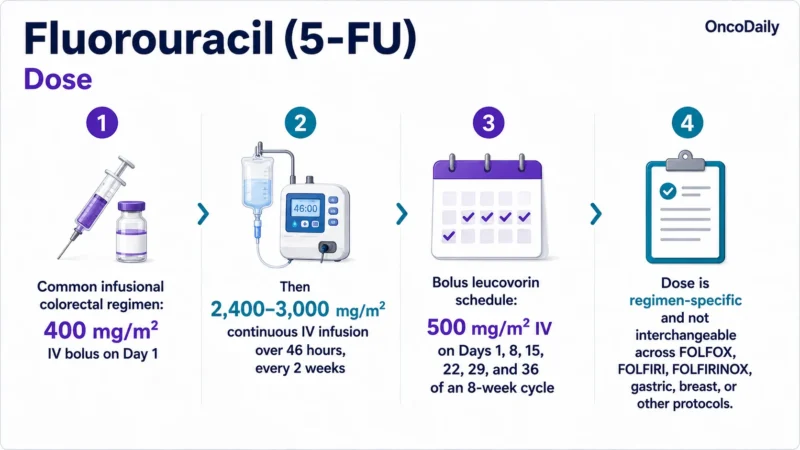
Fluorouracil dosing varies significantly by cancer type and treatment regimen.
Colorectal Cancer — Infusional Regimen
A labeled regimen is:
Fluorouracil 400 mg/m² IV bolus on Day 1, followed by 2,400–3,000 mg/m² as a continuous IV infusion over 46 hours every 2 weeks.
This schedule is commonly incorporated into regimens such as FOLFOX or FOLFIRI.
Colorectal Cancer — Bolus Regimen
A labeled bolus schedule with leucovorin is:
500 mg/m² IV on Days 1, 8, 15, 22, 29, and 36 of an 8-week cycle.
Pancreatic Cancer
A labeled infusional schedule is:
400 mg/m² IV bolus on Day 1 followed by 2,400 mg/m² continuous IV infusion over 46 hours every 2 weeks, as part of an appropriate combination regimen.
Gastric Cancer
Fluorouracil may be administered at approximately:
200–1,000 mg/m² per 24 hours by continuous IV infusion, depending on the platinum-containing regimen.
Breast Cancer
As part of cyclophosphamide-containing multidrug treatment:
500 or 600 mg/m² IV on Days 1 and 8 every 28 days for 6 cycles is a labeled approach.
These doses are regimen-specific and not interchangeable.
How Is Fluorouracil (5-FU) Administered?
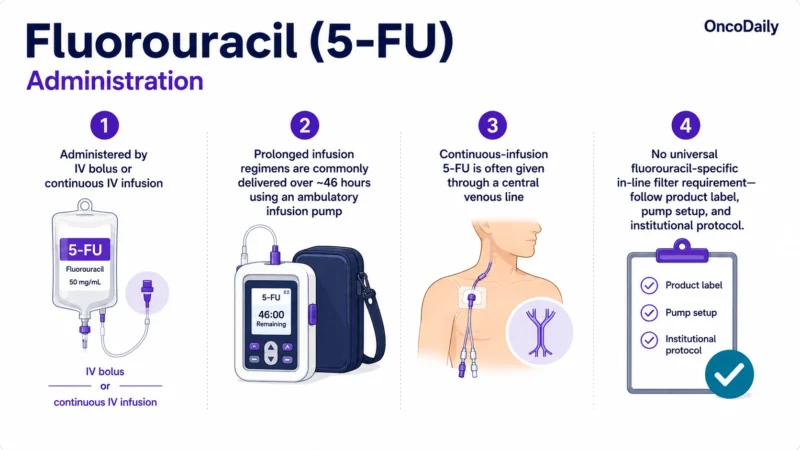
Fluorouracil injection is administered either as:
- Intravenous bolus
- Continuous intravenous infusion.
For prolonged infusion regimens, fluorouracil may be delivered using an ambulatory infusion pump over approximately 46 hours.
Some current labels specify administration of continuous-infusion fluorouracil through a central venous line using an infusion pump.
Administration depends heavily on the complete regimen. For example, in FOLFOX, oxaliplatin and leucovorin are typically administered before the fluorouracil bolus and continuous infusion.
Read more: Mark Lewis: Why I (Almost) Never Bolus 5-Fluorouracil on OncoDaily.
Does Fluorouracil Require an In-Line Filter?
There is no universal fluorouracil-specific in-line filter requirement across all injectable products and regimens.
Administration should follow:
- The specific fluorouracil product label
- Institutional chemotherapy procedures
- Infusion-pump requirements
- Instructions for the other drugs being administered in the regimen.
A filter requirement for another drug in a combination regimen should not automatically be applied to fluorouracil itself.
Is Premedication Required?
Fluorouracil does not require a universal drug-specific premedication regimen.
Supportive medications are selected according to the complete chemotherapy regimen and may include:
- Antiemetics
- Hydration when clinically appropriate
- Antidiarrheal treatment
- Mouth-care strategies for mucositis.
Patients with a previous hypersensitivity or infusion-related reaction require individualized management.
Are Dose Reductions Used?
Yes.
Fluorouracil may be withheld, reduced, or discontinued for clinically significant:
- Neutropenia
- Thrombocytopenia
- Severe diarrhea
- Mucositis
- Hand-foot syndrome
- Cardiotoxicity
- Neurotoxicity
- Hyperammonemic encephalopathy
- Severe or unexpected toxicity associated with DPD deficiency.
Dose modifications depend on the regimen, toxicity severity, and previous treatment tolerance.
What Is Known About Fluorouracil Pharmacokinetics?
Fluorouracil is rapidly metabolized after systemic administration.
Most fluorouracil catabolism is mediated by dihydropyrimidine dehydrogenase (DPD), encoded by the DPYD gene.
Because DPD is responsible for eliminating much of administered fluorouracil, reduced enzyme activity can cause markedly increased systemic exposure.
Fluorouracil has a relatively short plasma half-life, but continuous infusion maintains sustained drug exposure and produces a toxicity profile different from that of bolus administration.
Why Is DPD Deficiency Important With Fluorouracil?
DPD deficiency is one of the most clinically important determinants of fluorouracil toxicity.
Patients with complete or marked DPD deficiency may experience severe or life-threatening:
- Mucositis
- Diarrhea
- Neutropenia
- Neurotoxicity
- Multiorgan toxicity.
Unexpected severe toxicity early in treatment should prompt consideration of impaired fluoropyrimidine metabolism.
Are Renal or Hepatic Dose Adjustments Required?
Fluorouracil does not have a simple universal renal dose-adjustment algorithm comparable with some predominantly renally cleared cytotoxic drugs.
Dose selection should consider:
- Overall organ function
- Treatment regimen
- Baseline hepatic function
- Toxicity during prior cycles
- Concomitant drugs
- DPD status.
Patients with substantial hepatic impairment may require additional caution because fluorouracil metabolism occurs extensively in the liver.
What Did Fluorouracil (5-FU) Clinical Trials Show?
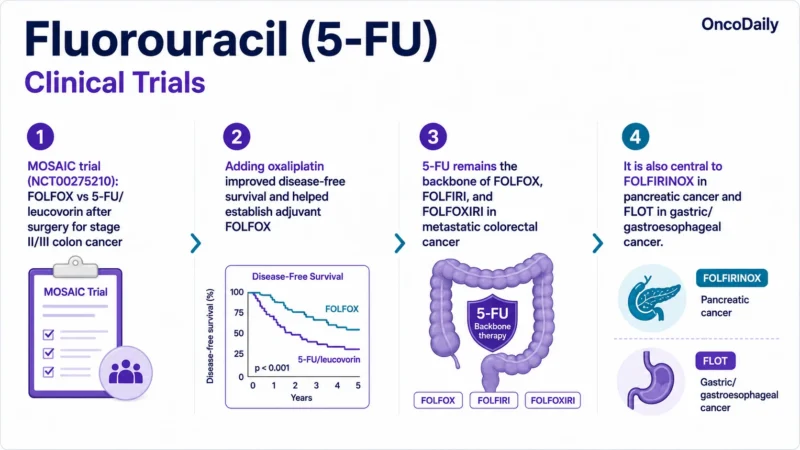
MOSAIC Trial — Adjuvant Colon Cancer
The pivotal MOSAIC trial, NCT00275210, compared FOLFOX with fluorouracil/leucovorin alone after surgery for stage II or III colon cancer.
Adding oxaliplatin to fluorouracil/leucovorin improved disease-free survival and helped establish FOLFOX as a major adjuvant regimen, particularly for stage III colon cancer.
Metastatic Colorectal Cancer
Fluorouracil/leucovorin has served as the backbone against which many modern colorectal regimens were developed.
Adding agents such as:
- Oxaliplatin → FOLFOX
- Irinotecan → FOLFIRI
- Oxaliplatin + irinotecan → FOLFOXIRI
improved treatment efficacy and established fluorouracil-based combination therapy as a central component of metastatic colorectal cancer management.
Pancreatic Cancer
Fluorouracil is a component of FOLFIRINOX, which combines:
- Fluorouracil
- Leucovorin
- Irinotecan
- Oxaliplatin.
Modified FOLFIRINOX remains an important systemic-treatment platform in several pancreatic-cancer settings.
Gastric and Gastroesophageal Cancer
Fluorouracil is frequently combined with platinum agents and other systemic therapies in gastric and gastroesophageal cancers.
It is also part of FLOT, which combines fluorouracil, leucovorin, oxaliplatin, and docetaxel.
Is Fluorouracil FDA Approved?
Yes.
Fluorouracil injection is an established FDA-approved chemotherapy used in multiple solid-tumor settings, including colorectal, breast, gastric, and pancreatic cancers.
Topical fluorouracil formulations are separately approved for selected dermatologic conditions, including actinic keratoses and certain superficial basal cell carcinomas.
What Is the Current Role of Fluorouracil (5-FU)?
Fluorouracil remains one of the most important chemotherapy backbones in modern oncology.
Its major roles include:
- FOLFOX for colorectal and other GI cancers
- FOLFIRI for colorectal cancer
- FOLFOXIRI in selected metastatic colorectal cancer settings
- FOLFIRINOX for pancreatic cancer
- FLOT for gastric and gastroesophageal cancers
- Fluorouracil/platinum combinations in selected head and neck cancers
- Selected breast cancer regimens.
Its continued use reflects its broad activity and ability to combine effectively with cytotoxic drugs, targeted agents, radiotherapy, and selected immunotherapy strategies.
What Are the Side Effects of Fluorouracil (5-FU)?
Important adverse effects include:
- Diarrhea
- Oral mucositis
- Nausea and vomiting
- Neutropenia
- Thrombocytopenia
- Anemia
- Hand-foot syndrome
- Cardiotoxicity
- Neurotoxicity
- Hyperammonemic encephalopathy
- Photosensitivity
- Increased risk of infection.
Myelosuppression
Fluorouracil can cause clinically significant neutropenia, thrombocytopenia, and anemia, particularly with bolus-containing schedules.
Mucositis and Diarrhea
Gastrointestinal toxicity may become severe and is particularly concerning when associated with DPD deficiency or unexpectedly high fluorouracil exposure.
Hand-Foot Syndrome
Palmar-plantar erythrodysesthesia is particularly associated with prolonged fluoropyrimidine exposure and may present with redness, tenderness, swelling, or peeling of the palms and soles.
Cardiotoxicity
Fluorouracil can cause cardiac toxicity, including:
- Chest pain
- Coronary vasospasm
- Myocardial ischemia
- Arrhythmias
- Rare myocardial infarction or cardiomyopathy.
New chest pain during fluorouracil therapy requires prompt clinical assessment.
Watch more: Learn about fluorouracil toxicity and supportive-care strategies in Fluorouracil (5-FU) Toxicities and Strategies for Management.
Written by Mirna Antabian, MD