













Irinotecan: Mechanism of Action, Dose, Administration, Clinical Uses, and Side Effects
Key takeaways
- Irinotecan is a prodrug converted to SN-38, a potent inhibitor of topoisomerase I.
- Inhibition of topoisomerase I prevents repair of single-strand DNA breaks, ultimately causing lethal DNA damage during replication.
- Conventional irinotecan is administered by IV infusion over approximately 90 minutes.
- FDA-labeled single-agent schedules include 125 mg/m² on Days 1, 8, 15, and 22 followed by a 2-week rest, or 350 mg/m² once every 3 weeks.
- FOLFIRI commonly uses irinotecan 180 mg/m² every 2 weeks with fluorouracil and leucovorin.
- Irinotecan can cause two clinically distinct forms of diarrhea: early cholinergic diarrhea and potentially life-threatening delayed diarrhea.
- Atropine may prevent or treat early cholinergic symptoms, while delayed diarrhea requires prompt antidiarrheal therapy and fluid/electrolyte management.
- Reduced UGT1A1 activity, particularly the UGT1A1*28/*28 genotype, increases the risk of severe neutropenia.
Irinotecan, also known as CPT-11, is a camptothecin-derived topoisomerase I inhibitor used most prominently in colorectal cancer. It is administered intravenously and is commonly incorporated into combination regimens such as FOLFIRI and FOLFIRINOX, while conventional irinotecan is also FDA approved as treatment for metastatic colorectal cancer.
This article aims to review irinotecan mechanism of action, dose, administration, clinical-trial findings, pharmacokinetics, pharmacogenomics, safety profile, and current role in cancer treatment.
Irinotecan Key Facts
- Generic name: Irinotecan hydrochloride
- Other name: CPT-11
- Brand name: Camptosar
- Drug class: Topoisomerase I inhibitor; camptothecin derivative
- Administration: Intravenous infusion
- Major approved use: Metastatic colorectal cancer
- Active metabolite: SN-38
- Common FOLFIRI dose: 180 mg/m² IV every 2 weeks, according to the specific regimen
- FDA-labeled single-agent schedules: 125 mg/m² weekly or 350 mg/m² every 3 weeks
- Infusion duration: Approximately 90 minutes
- Important pharmacogene: UGT1A1
- Major toxicities: Early cholinergic diarrhea, delayed diarrhea, neutropenia, nausea, vomiting, fatigue, and alopecia
- Boxed warning: Severe diarrhea and myelosuppression
- Approval status: FDA approved.
What Is Irinotecan?
Irinotecan is a semisynthetic camptothecin derivative and topoisomerase I inhibitor that causes unrepaired DNA damage in proliferating cancer cells.
Irinotecan itself has antitumor activity, but much of its clinical effect is mediated by its more active metabolite SN-38.
Its most established role is in metastatic colorectal cancer, where it may be used alone or within combination chemotherapy.
Common irinotecan-containing regimens include:
- FOLFIRI — irinotecan, fluorouracil, and leucovorin
- FOLFOXIRI — irinotecan, oxaliplatin, fluorouracil, and leucovorin
- FOLFIRINOX — irinotecan, oxaliplatin, fluorouracil, and leucovorin, particularly in pancreatic cancer.
Conventional irinotecan should not be confused with liposomal irinotecan, which is a distinct formulation with different dosing and approved indications.
Irinotecan Mechanism of Action
Irinotecan acts primarily through inhibition of DNA topoisomerase I.
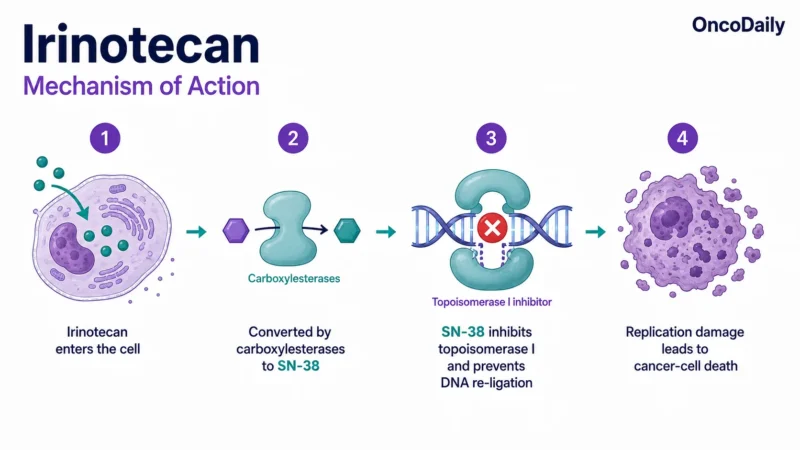
Its mechanism can be summarized in four stages:
- Irinotecan enters the cancer cell.
- Carboxylesterase enzymes convert irinotecan to the substantially more active metabolite SN-38.
- SN-38 stabilizes the complex formed between topoisomerase I and single-stranded DNA after cleavage.
- DNA re-ligation is prevented; when replication machinery encounters these complexes, irreversible DNA damage develops, ultimately leading to cancer-cell death.
Because this damage becomes particularly important during DNA replication, irinotecan has greater activity against proliferating cells.
What Is the Dose of Irinotecan?
Irinotecan dosing depends heavily on the cancer type, combination regimen, organ function, previous toxicity, and pharmacogenomic factors.
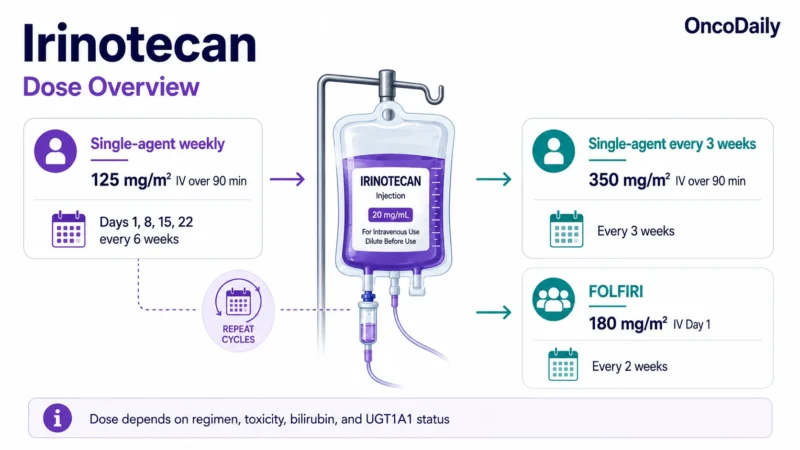
Single-Agent Irinotecan — Weekly Schedule
The FDA-labeled regimen is:
Irinotecan 125 mg/m² IV over 90 minutes on Days 1, 8, 15, and 22, followed by a 2-week rest.
Dose levels may subsequently be reduced to 100 or 75 mg/m² according to toxicity.
Single-Agent Irinotecan — Every 3 Weeks
Another FDA-labeled regimen is:
Irinotecan 350 mg/m² IV over 90 minutes once every 3 weeks.
Dose reductions to 300 or 250 mg/m² may be used when clinically indicated.
FOLFIRI
A widely used colorectal-cancer schedule includes approximately:
Irinotecan 180 mg/m² IV on Day 1 every 2 weeks
followed by leucovorin and fluorouracil according to the specific FOLFIRI protocol.
FOLFIRINOX
In pancreatic cancer, conventional FOLFIRINOX commonly incorporates:
Irinotecan 180 mg/m² IV every 2 weeks
although modified FOLFIRINOX schedules frequently use lower protocol-defined doses.
These are regimen-specific doses and should not be considered interchangeable.
How Is Irinotecan Administered?
Irinotecan hydrochloride is administered by intravenous infusion over approximately 90 minutes.
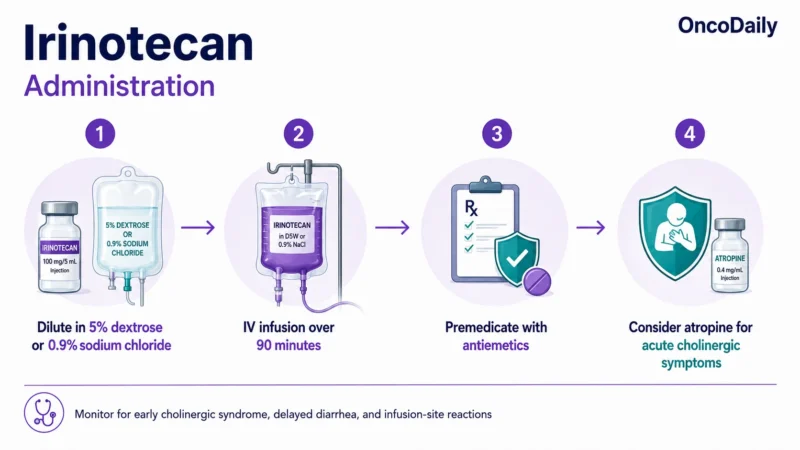
Before administration, the concentrate must be diluted. The FDA label specifies:
- 5% dextrose as the preferred diluent, or
- 0.9% sodium chloride
- Final irinotecan concentration: approximately 0.12–2.8 mg/mL
- Other medications should not be added to the irinotecan infusion solution.
The infusion site should be monitored for inflammation or extravasation.
Watch more: Learn about safe irinotecan administration and management of treatment-related toxicities in Administer Irinotecan Infusions With Confidence.
Does Irinotecan Require an In-Line Filter?
The conventional irinotecan prescribing information does not establish a universal drug-specific in-line filter requirement.
Preparation and administration should therefore follow:
- The specific product label
- Institutional chemotherapy procedures
- Infusion-device requirements
- Instructions for any other agents in the combination regimen.
This applies to conventional irinotecan; liposomal irinotecan has separate formulation-specific administration instructions.
Is Premedication Required?
Yes. Antiemetic premedication is recommended before irinotecan.
The prescribing information notes that clinical studies commonly used:
- Dexamethasone 10 mg
- Together with another antiemetic, such as a 5-HT3 antagonist
- Beginning at least 30 minutes before irinotecan administration.
Atropine
Irinotecan can produce an acute cholinergic syndrome during or shortly after infusion.
Symptoms may include:
- Early diarrhea
- Abdominal cramping
- Sweating
- Increased salivation
- Lacrimation
- Rhinitis
- Flushing
- Miosis
- Bradycardia.
The label recommends considering:
Atropine 0.25–1 mg IV or subcutaneously
for prophylaxis or treatment when cholinergic symptoms occur, unless contraindicated.
Are Dose Reductions Used?
Yes.
Irinotecan doses may be reduced, delayed, or withheld because of:
- Severe diarrhea
- Neutropenia
- Febrile neutropenia
- Thrombocytopenia
- Significant nonhematologic toxicity
- Increased bilirubin
- Previous pelvic or abdominal radiotherapy
- Reduced UGT1A1 activity.
For FDA-labeled single-agent treatment, a new cycle should generally not begin until:
- Granulocytes recover to ≥1,500/mm³
- Platelets recover to ≥100,000/mm³
- Treatment-related diarrhea has completely resolved.
Why Is UGT1A1 Important With Irinotecan?
UGT1A1 is a major pharmacogenomic determinant of irinotecan toxicity.
SN-38 undergoes glucuronidation primarily through UGT1A1. Reduced enzyme activity can increase SN-38 exposure and therefore increase the risk of toxicity, especially severe neutropenia.
Patients homozygous for the UGT1A1*28 allele are at increased risk. In one study using irinotecan 350 mg/m² every 3 weeks, grade 4 neutropenia occurred in:
- 50% of patients with UGT1A1*28/*28
- 12.5% of heterozygous patients
- 0% of patients with the wild-type genotype.
For patients known to be homozygous for UGT1A1*28, the FDA label recommends considering a starting-dose reduction of at least one dose level, although the exact optimal reduction is not defined.
What Is Known About Irinotecan Pharmacokinetics?
Irinotecan functions partly as a prodrug.
After administration:
- Carboxylesterases convert irinotecan to SN-38
- SN-38 has substantially greater topoisomerase I inhibitory activity than irinotecan itself
- SN-38 is glucuronidated by UGT1A1
- CYP3A4 also contributes to irinotecan metabolism.
Strong CYP3A4 inducers can reduce exposure to irinotecan and SN-38, whereas strong CYP3A4 or UGT1A1 inhibitors may increase systemic exposure. The prescribing information recommends avoiding these combinations when alternatives are available.
Are Renal or Hepatic Dose Adjustments Required?
Hepatic Impairment
Hepatic function is particularly important because bilirubin elevation is associated with increased irinotecan toxicity.
Clinical trials generally did not administer conventional irinotecan to patients with:
- Total bilirubin >2 mg/dL
- Transaminases >3× ULN without liver metastases
- Transaminases >5× ULN with liver metastases.
Patients with bilirubin of 1–2 mg/dL had an increased incidence of severe neutropenia with weekly dosing.
A lower starting dose may therefore be considered in patients with elevated bilirubin.
Renal Impairment
The pharmacokinetics of irinotecan have not been adequately evaluated in renal impairment.
The FDA label recommends caution in renal dysfunction and states that conventional irinotecan is not recommended for patients receiving dialysis.
Renal failure may also develop secondarily from severe diarrhea, vomiting, and volume depletion.
What Did Irinotecan Clinical Trials Show?
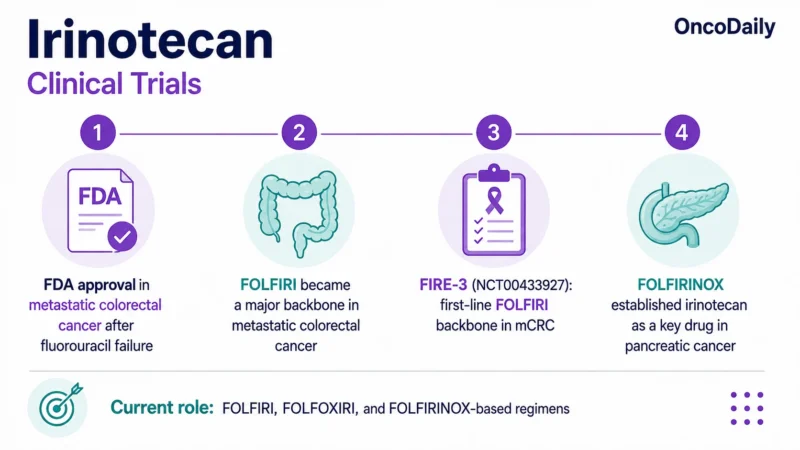
Irinotecan After Fluorouracil Failure
The FDA approval of single-agent irinotecan in metastatic colorectal cancer was supported by randomized Phase 3 studies in patients whose disease had progressed after fluorouracil-based therapy.
Across two comparative studies, 535 patients were evaluated, including patients receiving irinotecan, fluorouracil-based treatment, or best supportive care. These studies established a clinical role for irinotecan after fluorouracil failure.
FOLFIRI in Metastatic Colorectal Cancer
Combining irinotecan with fluorouracil and leucovorin produced the widely used FOLFIRI regimen.
Modern randomized studies continue to use FOLFIRI as a foundational first- or later-line treatment platform in metastatic colorectal cancer.
FIRE-3
The randomized Phase 3 FIRE-3 trial (NCT00433927) evaluated first-line FOLFIRI combined with targeted therapy in metastatic colorectal cancer, reinforcing FOLFIRI as an important backbone for molecularly selected treatment strategies.
FOLFOXIRI
More intensive regimens combine irinotecan with oxaliplatin, fluorouracil, and leucovorin, creating FOLFOXIRI.
This strategy is used in selected patients with metastatic colorectal cancer when greater treatment intensity is appropriate.
Pancreatic Cancer — FOLFIRINOX
Irinotecan is also a core component of FOLFIRINOX, alongside fluorouracil, leucovorin, and oxaliplatin.
The regimen established an important role for irinotecan-containing multidrug chemotherapy in pancreatic cancer, although this represents a broader protocol-based use beyond the principal conventional irinotecan FDA indication.
Is Irinotecan FDA Approved?
Yes.
Conventional irinotecan hydrochloride is FDA approved for metastatic colorectal cancer, including treatment of disease that has recurred or progressed following fluorouracil-based therapy.
It received its initial U.S. approval in 1996.
A distinct formulation, liposomal irinotecan, has separate FDA-approved uses in metastatic pancreatic cancer and should not be substituted dose-for-dose for conventional irinotecan.
What Is the Current Role of Irinotecan?
Irinotecan remains a major chemotherapy backbone in gastrointestinal oncology.
Its most important contemporary roles include:
- FOLFIRI for metastatic colorectal cancer
- FOLFOXIRI for selected patients with metastatic colorectal cancer
- Irinotecan-containing regimens combined with targeted agents such as anti-EGFR or anti-VEGF therapy
- FOLFIRINOX for pancreatic cancer
- Selected gastrointestinal and other solid-tumor treatment protocols.
Its ongoing importance reflects its broad antitumor activity and its ability to combine effectively with fluoropyrimidines, platinum compounds, targeted therapies, and newer systemic approaches.
Read more: Explore current systemic treatment approaches for colorectal cancer on OncoDaily.
What Are the Side Effects of Irinotecan?
Important adverse effects include:
- Diarrhea
- Neutropenia
- Leukopenia
- Anemia
- Nausea
- Vomiting
- Abdominal pain
- Loss of appetite
- Fatigue
- Fever
- Dehydration
- Alopecia
- Cholinergic symptoms
- Infection
- Rare interstitial lung disease.
Early Diarrhea and Cholinergic Syndrome
Early diarrhea occurs during or shortly after irinotecan infusion and is related to acute cholinergic activity.
It may occur with sweating, abdominal cramping, salivation, lacrimation, rhinitis, flushing, miosis, and occasionally bradycardia.
Atropine can be used for prevention or treatment when appropriate.
Delayed Diarrhea
Delayed diarrhea usually occurs more than 24 hours after treatment and can be life-threatening.
It may cause:
- Severe dehydration
- Electrolyte abnormalities
- Infection or sepsis
- Ileus
- Colitis
- Rare intestinal perforation.
Patients should have an appropriate antidiarrheal plan and begin treatment promptly when delayed diarrhea develops.
Neutropenia
Severe myelosuppression is included in the irinotecan boxed warning.
Febrile neutropenia requires treatment interruption, appropriate antimicrobial management, and subsequent dose adjustment when indicated.
Pulmonary Toxicity
Rare interstitial pulmonary disease–like events, including fatal cases, have been reported. New or worsening cough, dyspnea, or fever during therapy warrants evaluation and interruption of treatment while pulmonary toxicity is investigated.