













Mercaptopurine: Mechanism of Action, Dose, Administration, Clinical Uses, and Side Effects
Key takeaways
- Mercaptopurine is a cornerstone of ALL maintenance therapy, usually given daily as part of a multidrug maintenance regimen.
- It is converted intracellularly into thioguanine nucleotides (TGNs) that interfere with purine synthesis and become incorporated into DNA and RNA.
- The recommended starting dose is generally 1.5–2.5 mg/kg orally once daily, with subsequent adjustment according to blood counts and toxicity.
- TPMT and NUDT15 variants can markedly increase exposure to active thiopurine metabolites and the risk of severe myelosuppression.
- Patients with homozygous TPMT or NUDT15 deficiency may require 10% or less of the usual dose.
- Mercaptopurine should be taken consistently with or without food, because food can reduce drug exposure.
- The drug is not useful for treating CNS leukemia because penetration into cerebrospinal fluid is negligible.
- CBC and liver-function monitoring are central to safe long-term treatment.
Mercaptopurine, also called 6-mercaptopurine or 6-MP, is an oral thiopurine antimetabolite used primarily as part of maintenance therapy for acute lymphoblastic leukemia (ALL) in adults and children. It is available as tablets and oral suspension and is FDA approved for ALL maintenance in combination with other chemotherapy drugs.
This article aims to review mercaptopurine mechanism of action, dose, administration, pharmacokinetics, pharmacogenomics, clinical role, safety profile, and current use in oncology.
Mercaptopurine Key Facts
- Generic name: Mercaptopurine
- Other names: 6-MP, 6-mercaptopurine
- Drug class: Thiopurine antimetabolite; purine analog
- Main oncology use: ALL maintenance therapy
- Administration: Oral tablets or oral suspension
- Recommended starting dose: 1.5–2.5 mg/kg once daily, equivalent to approximately 50–75 mg/m² once daily
- Important pharmacogenes: TPMT and NUDT15
- Approval status: FDA approved
- Major toxicities: Myelosuppression, hepatotoxicity, infection, gastrointestinal toxicity, and treatment-related malignancies
- Important interaction: Mercaptopurine dose should be substantially reduced when used with allopurinol.
What Is Mercaptopurine?
Mercaptopurine is a purine analog and thiopurine antimetabolite that interferes with purine metabolism, DNA synthesis, and RNA function in rapidly dividing cells.
It has been used in leukemia therapy for decades and remains particularly important during the prolonged maintenance phase of ALL treatment. The FDA-approved indication is treatment of adults and children with ALL as part of a combination chemotherapy maintenance regimen.
Mercaptopurine is commonly combined with drugs such as methotrexate and periodic vincristine or corticosteroids according to the specific ALL protocol.
Mercaptopurine Mechanism of Action
Mercaptopurine acts after intracellular conversion into active thiopurine metabolites.
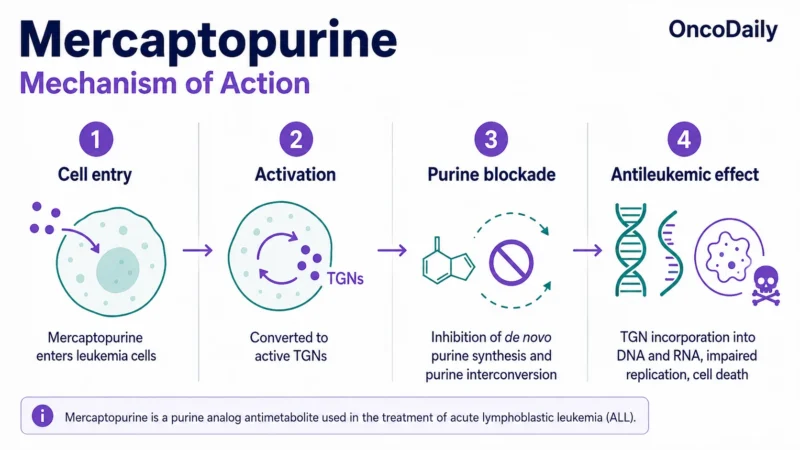
The mechanism involves:
- Mercaptopurine enters leukemia cells.
- It is converted into active metabolites including thioguanine nucleotides (TGNs).
- TGNs become incorporated into DNA and RNA.
- Mercaptopurine metabolites inhibit de novo purine synthesis.
- Purine nucleotide interconversion is disrupted.
- DNA replication and cellular proliferation are impaired.
- The resulting metabolic and genomic stress causes cell-cycle arrest and cell death.
The relative contribution of each biochemical pathway to mercaptopurine’s antileukemic effect is not completely defined.
What Is the Dose of Mercaptopurine?
For ALL maintenance, the recommended starting dosage is:
Mercaptopurine 1.5–2.5 mg/kg orally once daily
or approximately:
50–75 mg/m² orally once daily.
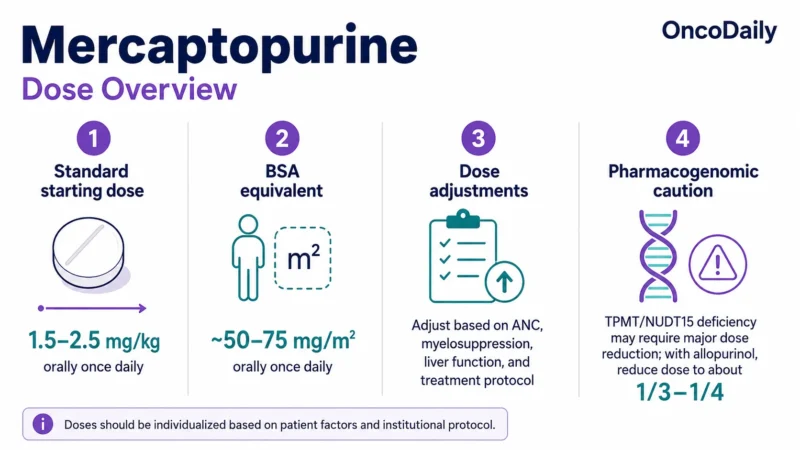
The dose is subsequently individualized according to:
- Absolute neutrophil count
- Degree of myelosuppression
- Treatment protocol
- TPMT and NUDT15 status
- Hepatic and renal function
- Concomitant medications.
Mercaptopurine is therefore not generally maintained at a fixed dose throughout therapy.
TPMT or NUDT15 Deficiency
Patients with reduced activity of these enzymes may tolerate substantially lower doses.
For homozygous TPMT or NUDT15 deficiency, patients typically require 10% or less of the standard recommended dose. Heterozygous patients may also require reduction based on treatment tolerance.
Watch more: Learn how TPMT and NUDT15 pharmacogenetics can guide mercaptopurine dosing in acute lymphoblastic leukemia in this pharmacogenetic workshop on 6-MP.
How Is Mercaptopurine Administered?
Mercaptopurine is administered orally. It is not given intravenously.
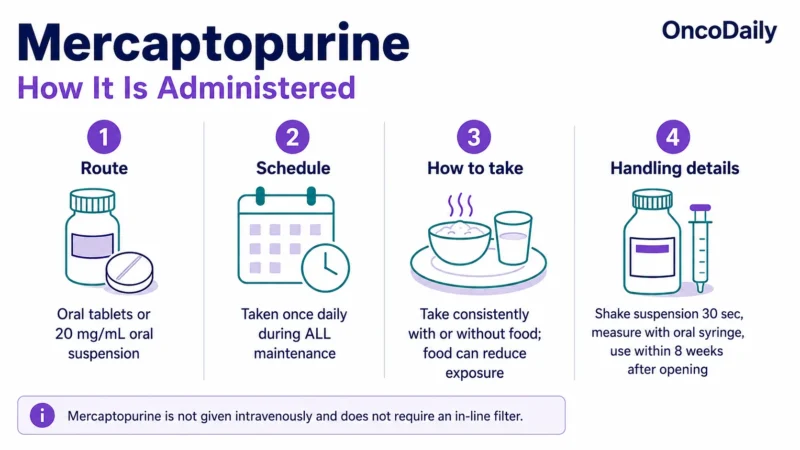
Available formulations include:
- 50-mg tablets
- 20 mg/mL oral suspension.
The medicine is generally taken once daily.
Patients should take mercaptopurine consistently either with food or without food, because food can reduce drug exposure.
For the oral suspension:
- Shake the bottle vigorously for at least 30 seconds
- Measure the prescribed dose with the supplied oral syringe
- Use the suspension within 8 weeks after opening.
Because mercaptopurine is cytotoxic, appropriate handling precautions should be followed.
Does Mercaptopurine Require an In-Line Filter?
No.
Mercaptopurine is an oral medication, so there is no IV infusion line, infusion bag, or in-line filter involved in its administration.
Is Premedication Required?
No routine mercaptopurine-specific premedication regimen is required.
Supportive treatment may be used when necessary for symptoms such as nausea or gastrointestinal intolerance, but standard antihistamine, corticosteroid, or infusion-reaction premedication is not required because mercaptopurine is given orally.
Are Dose Reductions Used?
Yes. Dose adjustment is an integral part of mercaptopurine therapy.
The dose may be reduced or temporarily withheld for:
- Excessive neutropenia
- Thrombocytopenia
- Severe or prolonged myelosuppression
- Hepatotoxicity
- Severe infection
- Significant gastrointestinal toxicity
- TPMT or NUDT15 deficiency.
CBC monitoring is used to keep the ANC within the desired protocol-defined range.
Interaction With Allopurinol
Allopurinol inhibits xanthine oxidase, one of the major pathways responsible for mercaptopurine inactivation.
When mercaptopurine is given with allopurinol, the current label recommends reducing the mercaptopurine dose to approximately one-third to one-quarter of the existing dose.
What Is Known About Mercaptopurine Pharmacokinetics?
Mercaptopurine is rapidly absorbed after oral administration.
Important pharmacokinetic characteristics include:
- Median Tmax: approximately 0.75 hours
- Median elimination half-life: approximately 1.3 hours
- Volume of distribution: approximately 0.9 L/kg
- Plasma protein binding: approximately 19%
- Negligible penetration into cerebrospinal fluid.
Food decreases systemic mercaptopurine exposure, which is why consistent administration relative to meals is recommended.
Mercaptopurine is metabolized through several competing pathways, including:
- TPMT-mediated methylation
- Xanthine oxidase-mediated oxidation
- Formation of active thioguanine nucleotides.
This metabolic complexity contributes substantially to variability in both efficacy and toxicity.
Why Are TPMT and NUDT15 Important With Mercaptopurine?
TPMT and NUDT15 are major pharmacogenomic determinants of mercaptopurine tolerance.
Patients with reduced activity of either enzyme accumulate higher intracellular levels of active thioguanine nucleotides and therefore have an increased risk of profound myelosuppression.
In a study of 1,028 children with ALL, approximate tolerated doses relative to the planned dose were:
- 50–90% in patients heterozygous for either TPMT or NUDT15
- 30–50% in patients heterozygous for both
- 5–10% in patients homozygous deficient for either enzyme.
The product label recommends considering TPMT and NUDT15 testing in patients who develop severe or recurrent myelosuppression.
Are Renal or Hepatic Dose Adjustments Required?
Renal Impairment
For creatinine clearance below 50 mL/min, the current oral-suspension label recommends using the lowest recommended starting dose or increasing the dosing interval to every 36–48 hours, with further adjustment based on ANC and toxicity.
Hepatic Impairment
Patients with hepatic impairment should generally start at the lowest recommended dose, followed by adjustment according to blood counts and adverse effects.
What Did Mercaptopurine Clinical Trials Show?
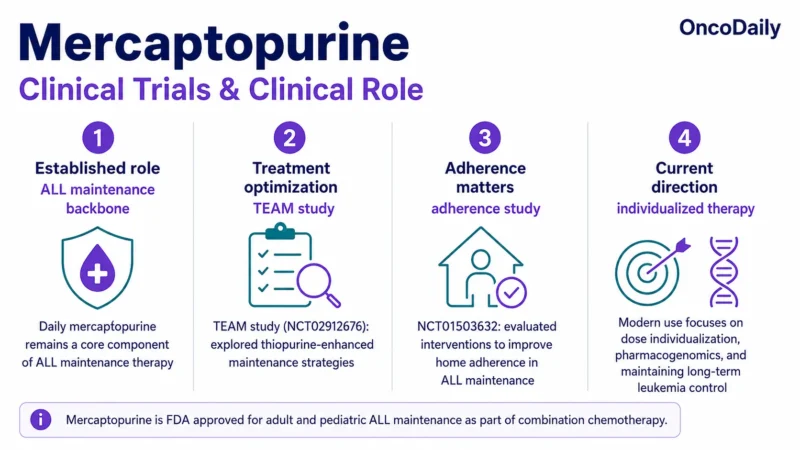
ALL Maintenance Therapy
Mercaptopurine has been incorporated into ALL maintenance therapy for decades, generally alongside weekly methotrexate and other protocol-defined agents.
Its role is supported by extensive cooperative-group experience rather than one contemporary registration trial. The objective of maintenance therapy is to maintain prolonged suppression of residual leukemic clones after remission has been achieved.
Adherence and Treatment Outcomes
Because mercaptopurine is taken at home for prolonged periods, adherence is an important determinant of treatment exposure.
The Phase 3 NCT01503632 study evaluated an intervention designed to improve adherence to oral mercaptopurine in children and young adults receiving ALL maintenance therapy.
Thiopurine-Enhanced Maintenance
The TEAM study, NCT02912676, investigated whether modifying thiopurine exposure during ALL maintenance could improve treatment effectiveness.
These studies illustrate the continued effort to optimize mercaptopurine exposure rather than replace its established role in ALL maintenance.
Is Mercaptopurine FDA Approved?
Yes.
Mercaptopurine is FDA approved for adult and pediatric acute lymphoblastic leukemia as part of combination maintenance chemotherapy.
Available U.S. formulations include tablets and oral suspension.
What Is the Current Role of Mercaptopurine?
Mercaptopurine remains an essential component of modern ALL maintenance therapy, especially in pediatric and adolescent/young-adult treatment protocols.
Its continuing importance reflects:
- Proven long-term antileukemic activity
- Convenient oral administration
- Compatibility with methotrexate-based maintenance
- Extensive clinical experience
- Ability to individualize exposure through CBC monitoring and
- pharmacogenomic information.
Unlike many newer targeted agents, mercaptopurine is generally not used as a short course. Maintenance treatment may continue for a prolonged period according to the specific ALL protocol.
Read more: Explore the role of maintenance therapy in acute lymphoblastic leukemia on OncoDaily.
What Are the Side Effects of Mercaptopurine?
Important adverse effects include:
- Myelosuppression
- Neutropenia
- Thrombocytopenia
- Anemia
- Infection
- Hepatotoxicity
- Nausea
- Vomiting
- Diarrhea
- Loss of appetite
- Rash
- Photosensitivity
- Rare treatment-related malignancies.
Myelosuppression
Myelosuppression is the most consistent dose-related toxicity. Severe neutropenia, thrombocytopenia, or anemia may require treatment interruption or dose reduction.
Hepatotoxicity
Mercaptopurine can cause clinically important liver injury, including jaundice and, rarely, hepatic necrosis.
Liver enzymes, alkaline phosphatase, and bilirubin should be monitored regularly. The label recommends withholding treatment when hepatotoxicity develops.
Infection
Immunosuppression and neutropenia increase susceptibility to infections. Responses to vaccines may also be reduced, and live-virus vaccination can pose additional risk in immunocompromised patients.
Written by Mirna Antabian, MD