













Mitomycin C: Mechanism of Action, Dose, Administration, Clinical Uses, and Side Effects
Key takeaways
- Mitomycin C is activated intracellularly and forms DNA cross-links, preventing normal DNA replication and transcription.
- Conventional systemic mitomycin is administered intravenously, whereas specialized formulations can be delivered locally into the urinary tract or bladder.
- A conventional labeled systemic dose is 20 mg/m² IV as a single dose every 6–8 weeks, with subsequent doses determined by hematologic recovery.
- Mitomycin remains an important radiosensitizer in anal cancer, typically combined with fluorouracil or another fluoropyrimidine during definitive radiation therapy.
- Delayed cumulative myelosuppression is a major dose-limiting toxicity of systemic mitomycin.
- Hemolytic uremic syndrome (HUS) is a particularly important serious complication associated with systemic exposure.
- Mitomycin is a vesicant, so extravasation can cause severe local tissue injury.
- In 2025, the FDA approved Zusduri, an intravesical mitomycin formulation, for recurrent low-grade intermediate-risk non-muscle-invasive bladder cancer.
Mitomycin C, usually referred to clinically as mitomycin, is a cytotoxic antineoplastic antibiotic with alkylating activity that damages DNA through bioreductive activation and DNA cross-link formation. Conventional systemic mitomycin has historically been used in gastrointestinal cancers and remains particularly important as a radiosensitizing component of chemoradiation for anal squamous cell carcinoma. Mitomycin is also used locally in urothelial cancer, including newer FDA-approved intravesical formulations.
This article aims to review mitomycin C mechanism of action, dose, administration, clinical-trial findings, pharmacokinetics, safety profile, and current role in oncology.
Mitomycin C Key Facts
- Generic name: Mitomycin
- Common name: Mitomycin C; MMC
- Drug class: Antineoplastic antibiotic; bioreductive alkylating agent
- Systemic administration: Intravenous
- Local administration: Intravesical formulations are available for selected urothelial cancers
- Conventional IV labeled uses: Disseminated gastric or pancreatic adenocarcinoma in combination therapy or as palliative therapy after other modalities have failed
- Common contemporary use: Mitomycin + fluoropyrimidine with radiotherapy for anal squamous cell carcinoma
- Conventional systemic dose: 20 mg/m² IV every 6–8 weeks, with subsequent dosing adjusted according to hematologic recovery
- Major toxicities: Delayed myelosuppression, hemolytic uremic syndrome, renal toxicity, pulmonary toxicity, mucositis, and severe tissue injury after extravasation
- Approval status: FDA approved; formulation and indication depend on the specific mitomycin product.
What Is Mitomycin C?
Mitomycin C is an antineoplastic antibiotic that becomes activated inside cells and produces covalent DNA damage, particularly interstrand DNA cross-links.
Mitomycin was originally derived from Streptomyces species. Despite being classified as an antineoplastic antibiotic, its activated metabolites behave functionally like alkylating agents by covalently modifying DNA.
Conventional IV mitomycin has an FDA-labeled role in combination treatment of disseminated gastric or pancreatic adenocarcinoma, particularly when other treatment modalities have failed.
In contemporary oncology, one of its most recognizable uses is chemoradiation for squamous cell carcinoma of the anal canal, where mitomycin is combined with fluorouracil or another fluoropyrimidine because of its radiosensitizing activity.
Mitomycin C Mechanism of Action
Mitomycin is a bioreductive DNA-damaging agent.
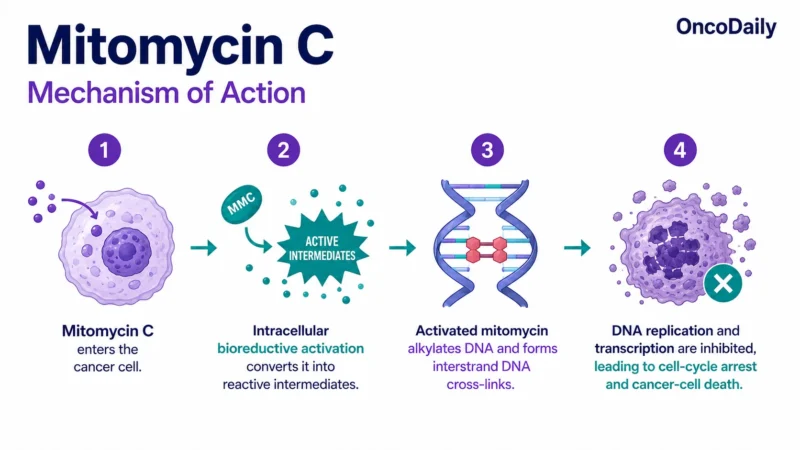
Its mechanism can be summarized in four stages:
- Mitomycin enters the cancer cell.
- Intracellular reduction converts the relatively inactive parent molecule into reactive intermediates.
- These intermediates alkylate DNA and produce interstrand DNA cross-links, particularly involving guanine-containing sequences.
- DNA replication and transcription are inhibited, ultimately producing cell-cycle arrest and cancer-cell death.
Activated mitomycin can also generate oxygen radicals and, at higher concentrations, interfere with RNA and protein synthesis.
Because bioreductive activation can occur under relatively hypoxic conditions, mitomycin has historically attracted interest as a cytotoxic agent against hypoxic tumor-cell populations.
What Is the Dose of Mitomycin C?
Mitomycin dosing depends heavily on the indication, formulation, and treatment protocol.
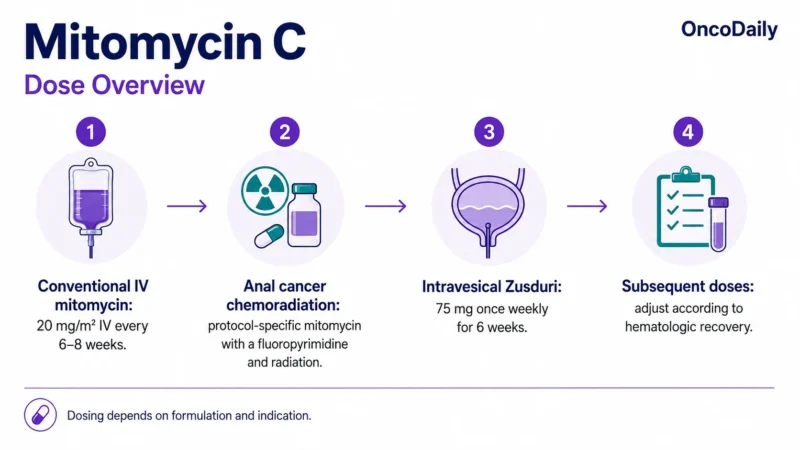
Conventional Intravenous Mitomycin
A traditional labeled systemic regimen is:
Mitomycin 20 mg/m² IV as a single dose every 6–8 weeks.
Doses above 20 mg/m² have not demonstrated additional effectiveness and increase the risk of toxicity. Subsequent doses should be adjusted according to the hematologic response to the preceding treatment.
Repeat dosing should generally be deferred until blood counts have adequately recovered.
Anal Cancer Chemoradiation
For anal squamous cell carcinoma, mitomycin dosing is protocol-specific and differs from the older systemic label.
A commonly used chemoradiation approach combines mitomycin with:
- Fluorouracil or another fluoropyrimidine
- Concurrent pelvic radiation therapy.
RTOG 98-11 and related studies helped establish mitomycin/fluorouracil-based chemoradiation as an important standard treatment platform.
Intravesical Mitomycin — ZUSDURI
For Zusduri, the FDA-approved dose is:
75 mg mitomycin intravesically once weekly for 6 consecutive weeks.
This formulation is specifically approved for adults with recurrent low-grade intermediate-risk non-muscle-invasive bladder cancer and should not be considered interchangeable with conventional IV mitomycin.
How Is Mitomycin C Administered?
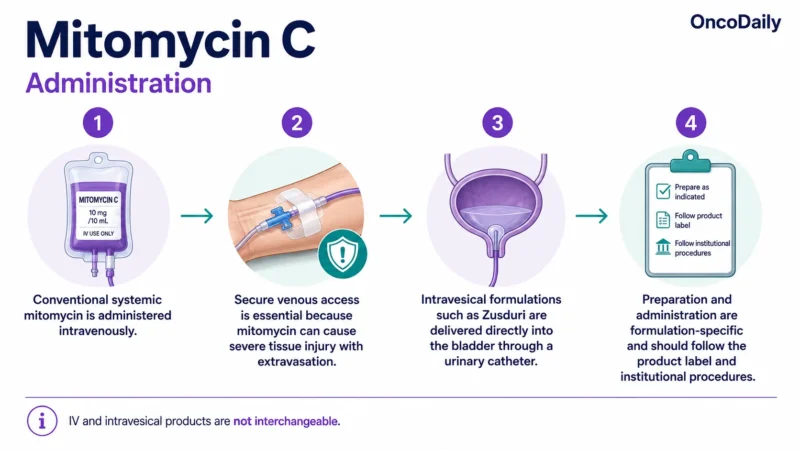
Intravenous Mitomycin
Conventional mitomycin for injection is given intravenously. Because it can cause severe tissue injury if extravasation occurs, secure venous access and careful monitoring of the injection site are essential.
Preparation and dilution depend on the specific manufacturer and formulation, so administration should follow the current product label and institutional chemotherapy procedures.
Intravesical Mitomycin
Intravesical products are administered directly into the bladder through a urinary catheter rather than systemically.
For Zusduri, mitomycin is reconstituted with a specialized hydrogel and then instilled into the bladder. The FDA label specifies that it is for intravesical use only and should not be administered by another route.
Does Mitomycin C Require an In-Line Filter?
There is no single universal in-line-filter requirement that applies to every mitomycin formulation.
For conventional IV mitomycin, preparation and administration should follow the specific product labeling and institutional procedures. Intravesical products such as Zusduri use a completely different delivery system and do not involve a conventional IV infusion line.
Is Premedication Required?
Mitomycin does not require one universal drug-specific premedication regimen.
For systemic chemotherapy, supportive care may include antiemetic prophylaxis according to:
- Mitomycin dose
- Partner chemotherapy
- Radiation therapy
- Patient-specific risk.
For anal-cancer chemoradiation, supportive care is driven by the complete fluoropyrimidine/mitomycin/radiotherapy regimen rather than mitomycin alone.
Are Dose Reductions Used?
Yes.
Systemic mitomycin may require dose reduction, treatment delay, or discontinuation because of:
- Leukopenia
- Thrombocytopenia
- Renal dysfunction
- Hemolytic uremic syndrome
- Severe pulmonary toxicity
- Significant mucosal or gastrointestinal toxicity
- Previous cumulative treatment exposure.
Subsequent systemic doses are traditionally adjusted according to the lowest leukocyte and platelet counts observed after the preceding dose.
Why Is Delayed Myelosuppression Important With Mitomycin C?
Bone-marrow suppression is one of the most important dose-limiting toxicities of systemic mitomycin.
Unlike some cytotoxic drugs with earlier count nadirs, mitomycin can produce delayed and cumulative leukopenia and thrombocytopenia, which may take several weeks to appear and recover.
CBC monitoring is therefore important both before treatment and during the weeks following systemic administration.
What Is Known About Mitomycin C Pharmacokinetics?
After IV administration, mitomycin is cleared relatively rapidly from plasma and undergoes extensive metabolic inactivation, particularly in the liver.
Only a portion of systemically administered drug is excreted unchanged in urine. Clearance may become less efficient with higher doses, contributing to nonlinear increases in exposure.
Local intravesical formulations are designed to maximize exposure within the urinary tract or bladder while limiting systemic exposure.
Are Renal or Hepatic Dose Adjustments Required?
Renal Function
Renal toxicity is an important concern with systemic mitomycin. The conventional prescribing information advises caution and monitoring of renal function because severe renal injury and HUS have been reported.
There is not one modern universally applicable creatinine-clearance dosing table across all mitomycin formulations.
Hepatic Function
Because systemic mitomycin undergoes substantial metabolic inactivation, liver dysfunction may potentially alter exposure, but the conventional label does not provide a simple standardized hepatic dose-reduction algorithm comparable with some other cytotoxic drugs.
Dose decisions should therefore follow the specific protocol, organ function, and treatment-related toxicity.
What Did Mitomycin C Clinical Trials Show?
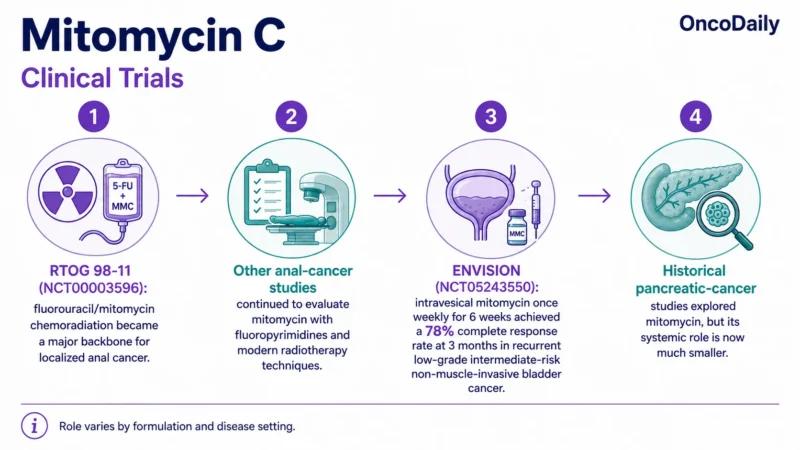
Anal Cancer — RTOG 98-11
The randomized Phase 3 RTOG 98-11 trial (NCT00003596) compared fluorouracil-based chemoradiation containing mitomycin with a cisplatin-containing strategy in patients with anal cancer.
Long-term analyses supported fluorouracil/mitomycin-based chemoradiation as a major treatment backbone for localized anal squamous cell carcinoma.
Other Anal-Cancer Chemoradiation Studies
Additional studies have continued to evaluate mitomycin with fluorouracil and modern radiotherapy techniques, including intensity-modulated radiation therapy.
Mitomycin remains important because randomized evidence demonstrated the value of retaining it within fluoropyrimidine-based chemoradiation rather than replacing it routinely with cisplatin.
ENVISION — Recurrent Low-Grade NMIBC
The Phase 3 ENVISION trial (NCT05243550) evaluated UGN-102, now marketed as Zusduri, in adults with recurrent low-grade intermediate-risk non-muscle-invasive bladder cancer.
Patients received 75 mg intravesical mitomycin once weekly for 6 weeks. Among 223 response-evaluable patients, the complete response rate at 3 months was 78%, and 79% of responders maintained their response for at least 12 months.
Pancreatic Cancer
Mitomycin has historically been investigated in advanced pancreatic cancer, including studies such as NCT00386399, although its role in pancreatic cancer has diminished considerably as more effective modern systemic regimens have emerged.
Is Mitomycin C FDA Approved?
Yes, but the approved indication depends strongly on the formulation.
Conventional mitomycin for injection carries a labeled role in combination treatment or palliation of disseminated gastric and pancreatic adenocarcinoma.
In June 2025, the FDA also approved Zusduri (mitomycin intravesical solution) for adults with recurrent low-grade intermediate-risk non-muscle-invasive bladder cancer.
Mitomycin is additionally used in other established oncology settings, particularly anal-cancer chemoradiation, according to disease-specific protocols.
What Is the Current Role of Mitomycin C?
The contemporary role of mitomycin differs substantially by disease.
Its most important roles include:
- Anal squamous cell carcinoma: radiosensitizing chemotherapy with a fluoropyrimidine during definitive chemoradiation.
- Non-muscle-invasive bladder cancer: local intravesical treatment, including the FDA-approved Zusduri formulation in recurrent low-grade intermediate-risk disease.
- Gastric and pancreatic cancer: historical FDA-labeled systemic indications, although mitomycin now has a much smaller role in contemporary systemic treatment.
Its continued relevance therefore comes less from broad systemic use and more from specific disease settings where its DNA cross-linking and radiosensitizing properties remain clinically useful.
Read more: Explore current approaches to anal cancer treatment on OncoDaily.
Watch more: Explore the clinical use of intravesical mitomycin C in bladder cancer in this Phase III trial overview.
What Are the Side Effects of Mitomycin C?
Important systemic toxicities include:
- Leukopenia
- Thrombocytopenia
- Anemia
- Infection
- Bleeding
- Nausea and vomiting
- Mucositis
- Fatigue
- Renal toxicity
- Hemolytic uremic syndrome
- Pulmonary toxicity
- Skin and tissue injury after extravasation.
Myelosuppression
Delayed bone-marrow suppression is the most common major systemic toxicity.
Thrombocytopenia and leukopenia can be cumulative and may require prolonged treatment delays or dose reduction.
Hemolytic Uremic Syndrome
A particularly serious mitomycin-associated complication is hemolytic uremic syndrome, characterized by:
- Microangiopathic hemolytic anemia
- Thrombocytopenia
- Renal dysfunction.
This syndrome can be severe or fatal and requires permanent discontinuation and urgent clinical management when suspected.
Pulmonary Toxicity
Mitomycin can rarely cause serious pulmonary toxicity, including interstitial pneumonitis and pulmonary fibrosis.
Extravasation
Mitomycin can cause significant tissue damage following extravasation. Careful venous access and site monitoring are therefore essential during systemic administration.
Intravesical Toxicity
Local intravesical mitomycin formulations have different adverse-effect profiles from systemic therapy. With Zusduri, adverse reactions are primarily related to urinary-tract and bladder exposure rather than the systemic toxicity pattern of conventional IV mitomycin.