













Topotecan: Mechanism of Action, Dose, Administration, Clinical Uses, and Side Effects
Key takeaways
- Topotecan inhibits topoisomerase I, preventing re-ligation of DNA single-strand breaks during replication.
- Collision of the replication machinery with the stabilized topotecan–topoisomerase I–DNA complex can produce irreversible double-strand DNA damage and cancer-cell death.
- IV monotherapy typically uses 1.5 mg/m² daily for 5 consecutive days every 21 days in ovarian cancer and SCLC.
- Cervical cancer treatment uses 0.75 mg/m² on Days 1–3 with cisplatin every 21 days.
- Severe neutropenia, thrombocytopenia, and anemia are major treatment-limiting toxicities and are reflected in the FDA boxed warning.
- Renal function significantly affects topotecan clearance, making renal dose adjustment particularly important.
- Oral topotecan is a distinct FDA-approved option for selected patients with relapsed SCLC.
- Topotecan remains clinically relevant despite the emergence of newer antibody-drug conjugates and immunotherapy approaches, especially in defined relapsed settings.
Topotecan is a semisynthetic camptothecin-derived topoisomerase I inhibitor used primarily in ovarian cancer, relapsed small cell lung cancer (SCLC), and recurrent or persistent cervical cancer. Intravenous topotecan is FDA approved as monotherapy for metastatic ovarian cancer and platinum-sensitive recurrent SCLC, and with cisplatin for stage IV-B, recurrent, or persistent cervical cancer not amenable to curative treatment.
This article aims to review topotecan mechanism of action, dose, administration, clinical-trial findings, pharmacokinetics, safety profile, and current role in cancer treatment.
Topotecan Key Facts
- Generic name: Topotecan hydrochloride
- Brand name: Hycamtin
- Drug class: Topoisomerase I inhibitor; camptothecin analog
- Administration: Intravenous infusion; an oral capsule formulation is also available for relapsed SCLC
- Main IV indications: Metastatic ovarian cancer, platinum-sensitive recurrent SCLC, and cervical cancer with cisplatin
- Standard IV monotherapy dose: 1.5 mg/m² IV over 30 minutes daily for 5 days every 21 days
- Cervical cancer dose: 0.75 mg/m² IV over 30 minutes on Days 1–3 every 21 days, with cisplatin 50 mg/m² on Day 1
- Oral SCLC dose: 2.3 mg/m² orally once daily for 5 days every 21 days
- Major toxicity: Severe myelosuppression
- Important renal adjustment: 0.75 mg/m²/day IV for CrCl 20–39 mL/min when used as monotherapy
- Approval status: FDA approved.
What Is Topotecan?
Topotecan is a water-soluble semisynthetic derivative of camptothecin that inhibits DNA topoisomerase I.
Topoisomerase I normally helps relieve torsional strain that develops as DNA unwinds during replication. It does this by creating temporary single-strand breaks and then re-ligating the DNA.
Topotecan interferes with the re-ligation step, converting a normal DNA-repair process into potentially lethal DNA damage.
FDA-approved IV indications include:
- Metastatic ovarian cancer after progression on or after chemotherapy
- Platinum-sensitive SCLC that progressed after first-line chemotherapy
- Stage IV-B, recurrent, or persistent cervical cancer, in combination with cisplatin.
An oral capsule formulation is separately approved for relapsed SCLC after a previous complete or partial response.
Topotecan Mechanism of Action
Topotecan acts primarily during DNA synthesis.
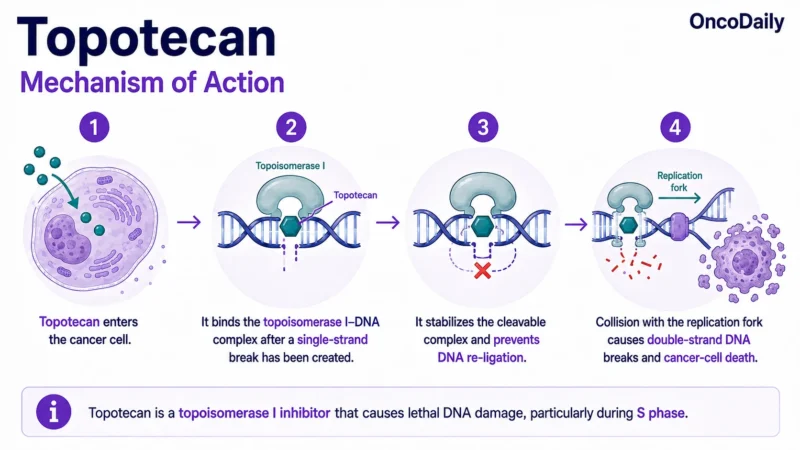
Its mechanism can be summarized in four stages:
- Topotecan enters the cancer cell.
- It binds to the complex formed between topoisomerase I and DNA after the enzyme creates a temporary single-strand break.
- Topotecan prevents DNA re-ligation, stabilizing the cleavable complex.
- When DNA replication machinery encounters this trapped complex, double-strand DNA damage develops, disrupting replication and promoting cancer-cell death.
Because this damage is particularly important during DNA replication, topotecan is considered strongly S-phase active.
Watch more: Small Cell Lung Cancer: Treatment and Clinical Management
What Is the Dose of Topotecan?
Topotecan dosing depends on the cancer type, formulation, renal function, previous toxicity, and treatment regimen.
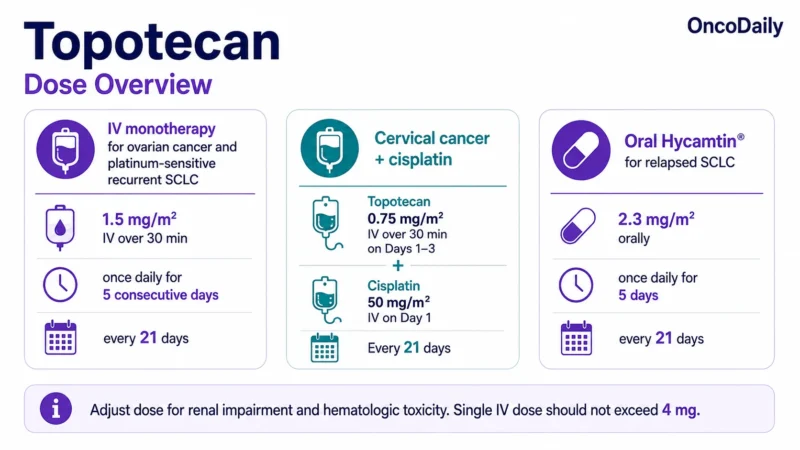
Ovarian Cancer
The FDA-recommended dose is:
Topotecan 1.5 mg/m² IV over 30 minutes once daily for 5 consecutive days, beginning on Day 1 of a 21-day cycle.
Treatment continues until disease progression or unacceptable toxicity.
Small Cell Lung Cancer
For IV treatment:
Topotecan 1.5 mg/m² IV over 30 minutes once daily on Days 1–5 every 21 days.
For oral Hycamtin:
Topotecan 2.3 mg/m² orally once daily for 5 consecutive days every 21 days.
Cervical Cancer
When combined with cisplatin:
Topotecan 0.75 mg/m² IV over 30 minutes on Days 1, 2, and 3
plus:
Cisplatin 50 mg/m² IV on Day 1
of each 21-day cycle.
For IV dosing, the label states that a single dose should generally not exceed 4 mg.
These schedules are indication- and formulation-specific and should not be interchanged.
How Is Topotecan Administered?
Intravenous Topotecan
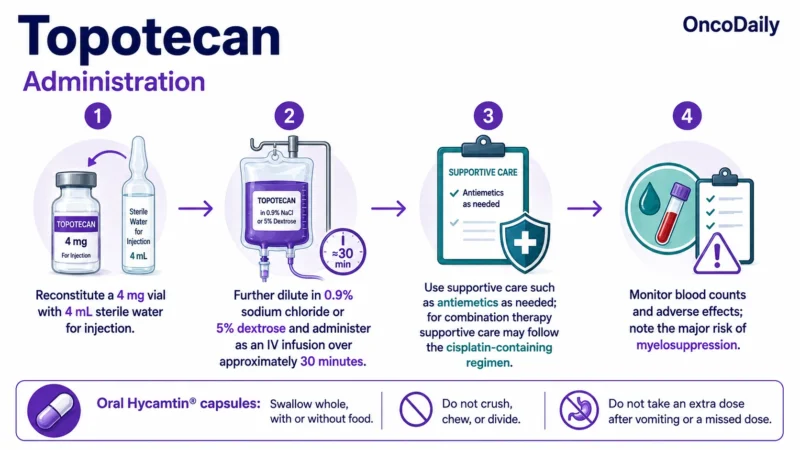
Topotecan hydrochloride for injection is administered intravenously over approximately 30 minutes.
For a commonly available 4-mg vial:
- Reconstitute with 4 mL sterile water for injection
- Further dilute in 0.9% sodium chloride or 5% dextrose
- Administer as a 30-minute IV infusion
- Protect the prepared infusion from light according to product-label storage instructions.
Because the vial contains no preservative, the reconstituted product should be used promptly according to the specific product instructions.
Oral Topotecan
Hycamtin capsules should be swallowed whole and may be taken with or without food.
They should not be:
- Chewed
- Crushed
- Divided.
If a dose is missed or vomiting occurs after administration, the label instructs patients not to take an additional replacement dose.
Does Topotecan Require an In-Line Filter?
The current prescribing information for conventional IV topotecan does not establish a universal topotecan-specific in-line filter requirement.
Administration should therefore follow:
- The specific manufacturer’s prescribing information
- Institutional chemotherapy procedures
- Requirements of the infusion system
- Instructions for any accompanying therapies.
The drug is administered after dilution in an appropriate IV solution over approximately 30 minutes.
Is Premedication Required?
Topotecan does not have a universal drug-specific hypersensitivity premedication requirement.
Antiemetic prophylaxis may be administered according to:
- Topotecan schedule
- Combination regimen
- Patient-specific nausea risk
- Institutional antiemetic guidelines.
When topotecan is combined with cisplatin, supportive care is driven substantially by the cisplatin-containing regimen, which typically requires more intensive nausea and hydration management.
Are Dose Reductions Used?
Yes.
Dose reduction and treatment delay are important parts of topotecan management.
A subsequent IV cycle should not generally begin until:
- Neutrophils recover to >1,000/mm³
- Platelets recover to >100,000/mm³
- Hemoglobin recovers to ≥9 g/dL, with transfusion if necessary.
Single-Agent Topotecan
Reduce from:
1.5 mg/m²/day → 1.25 mg/m²/day
after severe neutropenia or platelets below 25,000/mm³, according to the FDA label. G-CSF may be used as an alternative strategy in selected circumstances.
Topotecan + Cisplatin
For severe febrile neutropenia or severe thrombocytopenia, the topotecan dose may be reduced to:
0.6 mg/m²/day
and, if necessary:
0.45 mg/m²/day.
What Is Known About Topotecan Pharmacokinetics?
After IV administration, topotecan exposure increases approximately proportionally with dose across clinically studied ranges.
Important pharmacokinetic characteristics include:
- Plasma-protein binding: approximately 35%
- Terminal half-life: approximately 2–3 hours
- Reversible conversion between the pharmacologically active lactone form and an open-ring hydroxy-acid form
- Substantial elimination through urine
- Smaller fecal contribution to elimination.
Approximately 51% of an IV dose was recovered in urine as total topotecan in the pharmacokinetic data summarized in the label.
Are Renal or Hepatic Dose Adjustments Required?
Renal Impairment
Renal function is particularly important because topotecan clearance declines as creatinine clearance decreases.
For IV topotecan used as a single agent:
CrCl 20–39 mL/min → reduce to 0.75 mg/m²/day.
The pharmacokinetic label data show that topotecan lactone clearance decreased by approximately 65% in patients with CrCl 20–39 mL/min compared with those with CrCl above 60 mL/min.
For oral Hycamtin:
- CrCl 30–49 mL/min: 1.5 mg/m²/day
- CrCl <30 mL/min: 0.6 mg/m²/day.
Hepatic Impairment
The IV label reports no clinically significant pharmacokinetic differences based on hepatic impairment in the studied population.
Unlike renal impairment, there is no comparable standardized hepatic dose-reduction table in the current conventional IV label.
What Did Topotecan Clinical Trials Show?
Ovarian Cancer — Study 039
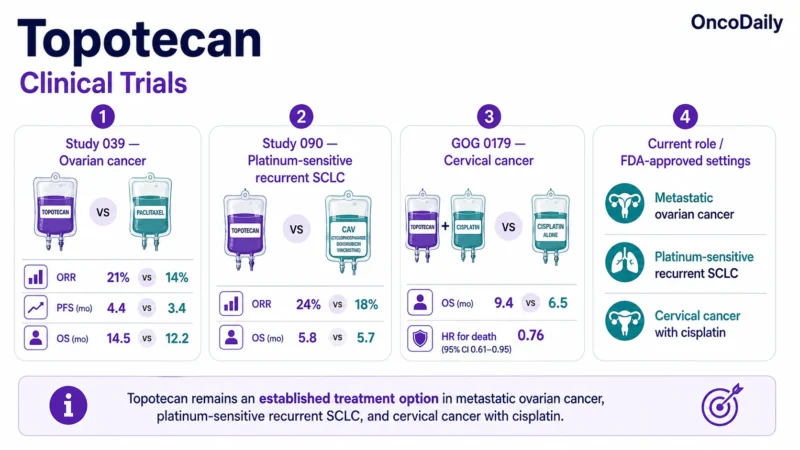
In a randomized study involving patients with recurrent ovarian cancer after platinum-containing therapy, 112 patients received topotecan and 114 received paclitaxel.
The objective response rate was:
- 21% with topotecan
- 14% with paclitaxel.
Median progression-free time was:
- 4.4 months
- versus 3.4 months.
Median overall survival was:
- 14.5 months with topotecan
- 12.2 months with paclitaxel.
The study did not demonstrate statistically significant superiority across the major efficacy endpoints, but it established antitumor activity in recurrent ovarian cancer, including some patients with platinum-resistant disease.
Small Cell Lung Cancer — Study 090
A randomized trial compared topotecan with CAV — cyclophosphamide, doxorubicin, and vincristine — in 211 patients with recurrent SCLC sensitive to previous chemotherapy.
Objective response rates were:
- 24% with topotecan
- 18% with CAV.
Median overall survival was:
- 5.8 months
- versus 5.7 months, respectively.
Topotecan also produced improvement in several disease-related symptoms, including dyspnea, fatigue, hoarseness, cough, and anorexia in subsets of patients.
Cervical Cancer — GOG 0179
The randomized GOG 0179 study evaluated topotecan plus cisplatin versus cisplatin alone in 147 patients with stage IV-B, recurrent, or persistent cervical cancer not amenable to curative therapy.
Median overall survival was:
- 9.4 months with topotecan + cisplatin
- 6.5 months with cisplatin alone.
The unadjusted hazard ratio for death was 0.76, supporting the FDA-approved combination.
Is Topotecan FDA Approved?
Yes.
Intravenous topotecan is FDA approved for:
- Metastatic ovarian cancer after disease progression
- Platinum-sensitive recurrent SCLC
- Stage IV-B, recurrent, or persistent cervical cancer, in combination with cisplatin.
Oral Hycamtin capsules are separately approved for relapsed SCLC in patients with a prior complete or partial response who are at least 45 days from completion of first-line chemotherapy.
What Is the Current Role of Topotecan?
Topotecan remains an established cytotoxic treatment option, particularly in:
- Relapsed SCLC
- Selected recurrent ovarian cancer settings
- Recurrent or persistent cervical cancer in combination with cisplatin.
Its modern role must be considered alongside newer systemic options, but topotecan remains an important reference chemotherapy and treatment option in appropriately selected patients.
Read more: Explore the evolving treatment landscape of platinum-resistant ovarian cancer on OncoDaily.
What Are the Side Effects of Topotecan?
Important adverse effects include:
- Neutropenia
- Thrombocytopenia
- Anemia
- Febrile neutropenia
- Infection
- Sepsis
- Nausea
- Vomiting
- Diarrhea
- Fatigue
- Alopecia
- Abdominal symptoms
- Interstitial lung disease
- Extravasation-related tissue injury.
Myelosuppression
Severe myelosuppression is the major dose-limiting toxicity of topotecan and carries an FDA boxed warning.
Across 879 patients with ovarian cancer or SCLC treated with IV monotherapy:
- Grade 4 neutropenia occurred in 78%
- Grade 4 thrombocytopenia in 27%
- Grade 3–4 anemia in 37%
- Febrile neutropenia occurred in approximately 5%.
The first cycle should be administered only when baseline neutrophils are at least 1,500/mm³ and platelets at least 100,000/mm³.
Interstitial Lung Disease
Topotecan can rarely cause interstitial lung disease, including fatal cases.
Risk factors include:
- Previous ILD
- Pulmonary fibrosis
- Lung cancer
- Thoracic radiation
- Other pneumotoxic treatments.
Confirmed treatment-related ILD requires permanent discontinuation.
Typhlitis
Topotecan can cause neutropenic enterocolitis, or typhlitis.
The diagnosis should be considered when a patient develops the combination of:
- Fever
- Neutropenia
- Abdominal pain.
Extravasation
Extravasation can occur with IV topotecan and has included severe cases. Administration should be stopped promptly when extravasation is suspected and managed according to institutional protocols.