





Hormone receptor-positive, HER2-negative breast cancer has historically been defined by one reassuring principle: endocrine therapy is the backbone of treatment.
That remains true in 2026.
What has changed is everything around it.
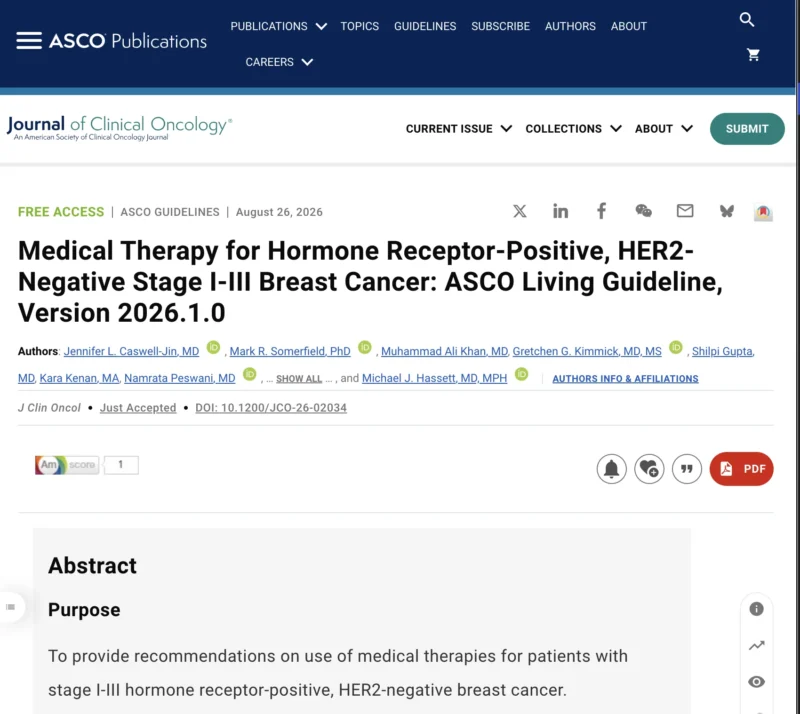
The new ASCO Living Guideline, Version 2026.1.0, for medical therapy of stage I–III hormone receptor-positive, HER2-negative breast cancer brings chemotherapy, endocrine therapy, CDK4/6 inhibition, PARP inhibition, genomic assays, neoadjuvant treatment and prognostic assessment into a single disease-specific framework.
Rather than asking only which treatment belongs to which stage, the guideline increasingly asks a more clinically relevant question:
How much residual risk does this individual patient have, and how much treatment is justified by that risk?
That distinction may be the most important message of the guideline.
ASCO reviewed 45 randomized clinical trials published between 2018 and 2026, together with individual-patient meta-analyses and retrospective studies, to construct recommendations spanning diagnosis through completion of systemic treatment. Endocrine therapy remains the foundation, but chemotherapy and targeted therapies are increasingly layered according to clinicopathologic risk, genomic biology, treatment tolerance and patient preference.
From Stage-Based Treatment to Risk-Adapted Treatment
One of the most important conceptual changes is the way ASCO organizes the guideline itself.
Instead of maintaining separate guidance documents organized primarily around treatment scenarios, the new framework is built around tumor biology, HR-positive/HER2-negative disease, and follows the patient longitudinally through treatment. The guideline explicitly recognizes that modern breast oncology is increasingly structured around biological subtype rather than simply around whether therapy is neoadjuvant or adjuvant.
That mirrors what is happening clinically.
Stage remains essential, but stage alone no longer determines systemic therapy intensity.
Tumor size, nodal involvement, grade, ER and PR expression, Ki-67, menopausal status, genomic assays, response to neoadjuvant therapy, comorbidities and competing mortality risks increasingly need to be interpreted together.
In other words, the treatment pathway is becoming:
biology + anatomy + genomic risk + patient factors → estimated absolute risk → treatment intensity.
This is particularly visible in decisions surrounding chemotherapy and adjuvant targeted therapy.
Endocrine Therapy Remains the Foundation, but Not Every HR-Positive Tumor Is Biologically Equivalent
ASCO continues to recommend adjuvant endocrine therapy for nearly all patients with stage I–III HR-positive/HER2-negative breast cancer.
But even here, the guideline moves away from treating hormone receptor positivity as a completely binary biomarker.
For tumors with very low ER and PR expression, for example, below approximately 5% by immunohistochemistry, the expected benefit from endocrine therapy may be limited and the evidence is less certain. Treatment therefore becomes an individualized discussion rather than an automatic assumption based solely on receptor labeling.
The same risk-based principle determines endocrine treatment intensity.
For premenopausal patients, tamoxifen alone, ovarian function suppression plus tamoxifen, and ovarian suppression plus an aromatase inhibitor remain options. However, ASCO favors ovarian suppression plus an aromatase inhibitor for patients at higher risk of distant recurrence.
Notably, the Expert Panel provides a pragmatic risk framework: ovarian suppression plus an aromatase inhibitor is generally recommended when the estimated 10-year risk of breast cancer death exceeds 10%, while it may still be considered selectively below that threshold.
For postmenopausal patients, aromatase inhibitors remain preferred, while tamoxifen remains a reasonable alternative when toxicity, osteoporosis or other clinical factors make an AI less appropriate.
Treatment duration follows the same philosophy.
Five years remains the minimum standard for most patients, while extension toward 10 years becomes increasingly relevant as late recurrence risk rises. Importantly, ASCO recognizes tools such as CTS5, PAM50 ROR, EndoPredict and Breast Cancer Index as potential contributors to the decision about extended endocrine therapy.
The result is a more individualized endocrine strategy: not simply whether to give endocrine therapy, but which endocrine therapy, how intensively, and for how long.
Chemotherapy Is Becoming a Risk-Integration Decision
The guideline also reinforces that chemotherapy selection should no longer rely on a single clinicopathologic variable.
ASCO recommends integrating tumor size, grade, lymphovascular invasion, nodal burden, ER and PR expression, Ki-67, genomic assays such as Oncotype DX and MammaPrint, age, menopausal status, comorbidity and estimated chemotherapy benefit.
This matters because the relevant question is not whether chemotherapy works in HR-positive breast cancer.
It does.
The more difficult question is whether the absolute benefit is large enough for a particular patient to justify its toxicity.
The guideline therefore preserves both anthracycline-taxane and non-anthracycline approaches. Non-anthracycline regimens are favored when recurrence risk is lower or cardiovascular risk is important, while anthracycline-taxane combinations remain appropriate when disease risk and expected chemotherapy benefit are higher.
This is a subtle but important evolution.
Modern treatment is not necessarily about replacing chemotherapy with targeted therapy. It is about determining which patients need chemotherapy at all, which need the most intensive chemotherapy, and which can safely avoid unnecessary exposure.
Neoadjuvant Therapy Is Not Simply a Chemotherapy Question
The guideline also clarifies the increasingly nuanced role of neoadjuvant treatment in luminal breast cancer.
For postmenopausal patients who would not otherwise require chemotherapy, neoadjuvant endocrine therapy is a legitimate strategy, particularly when tumor downstaging may facilitate breast conservation.
Aromatase inhibitors are preferred, and treatment often needs several months to achieve maximal response. By contrast, routine neoadjuvant endocrine therapy remains less established in premenopausal patients and is generally not recommended outside a clinical trial unless chemotherapy is contraindicated.
Importantly, the guideline does not endorse neoadjuvant CDK4/6 inhibition as routine practice. Despite substantial biological interest in this strategy, ASCO concludes that evidence remains insufficient to recommend for or against its use in standard neoadjuvant management.
The exception at the opposite biological extreme is also important.
Stage II–III cancers with less than 10% hormone receptor expression may be treated using a triple-negative-like neoadjuvant approach incorporating taxane, carboplatin, anthracycline and pembrolizumab.
That recommendation reflects an increasingly important reality: a tumor can technically meet the definition of HR-positive disease while behaving biologically much closer to TNBC.
CDK4/6 Inhibition Has Moved Into the Core Adjuvant Conversation
Perhaps the clearest example of treatment escalation is adjuvant CDK4/6 inhibition.
ASCO now places both abemaciclib and ribociclib firmly within the treatment framework for appropriately selected high-risk disease.
Abemaciclib for two years alongside endocrine therapy may be offered according to the monarchE population: stage II–III disease with at least four positive axillary nodes, or one to three positive nodes with additional high-risk features.
Ribociclib for three years may be offered according to NATALEE criteria, extending eligibility into a broader stage II–III population, including selected high-risk node-negative T2 disease defined by grade, Ki-67 or genomic risk.
But the most interesting part of the guideline may be what comes next.
ASCO explicitly acknowledges that not every patient who technically meets a trial eligibility criterion will derive enough absolute benefit to justify years of additional therapy.
The Expert Panel proposes an approximate risk framework:
CDK4/6 inhibition is generally recommended when estimated 10-year breast cancer mortality exceeds 25%, considered when risk is between 10% and 25%, and generally not recommended when risk is below 10%.
This is an important step toward translating relative treatment effects into clinically meaningful absolute benefit.
It also changes how monarchE and NATALEE should be interpreted in practice.
Trial eligibility answers the question:
- Could this patient have entered the study?
Risk estimation asks a different question:
- Is the expected benefit large enough that this patient should receive the treatment?
Those are not always the same thing.
For patients eligible for both strategies, the Expert Panel favors abemaciclib in part because of its shorter treatment duration and because, at the time of this guideline, it has demonstrated a statistically significant overall survival benefit.
At the same time, CDK4/6 inhibition should not be interpreted as a replacement for chemotherapy when chemotherapy is otherwise indicated.
Olaparib Expands the Precision-Therapy Discussion Beyond BRCA1/2
The PARP inhibitor recommendation is another particularly consequential element.
ASCO recommends one year of adjuvant olaparib for patients with high-risk stage II–III HR-positive/HER2-negative breast cancer carrying germline BRCA1, BRCA2 or PALB2 pathogenic or likely pathogenic variants following chemotherapy and definitive local treatment.
The inclusion of PALB2 is notable because OlympiA itself enrolled germline BRCA1/2 carriers; the Expert Panel extends the recommendation to PALB2 based on biological rationale and evidence from metastatic disease.
Another clinically important question arises when patients appear eligible for both olaparib and CDK4/6 inhibition.
Here ASCO prioritizes olaparib in high-risk germline BRCA1/2-associated disease because of the magnitude of benefit demonstrated in OlympiA and uncertainty surrounding the specific benefit of CDK4/6 inhibition in germline BRCA carriers.
Sequential olaparib followed by a CDK4/6 inhibitor has not been prospectively studied, although the guideline notes that it could be considered in exceptionally high-risk, highly motivated patients.
This is likely to become an increasingly important practical sequencing question as more patients qualify for multiple adjuvant targeted strategies.
Prognosis Is Becoming a Treatment Biomarker
Perhaps the most forward-looking aspect of the guideline is that risk itself increasingly functions like a biomarker.
The document repeatedly moves away from rigid yes-or-no treatment rules and instead asks clinicians to estimate absolute recurrence and mortality risk.
Tumor size and nodal status remain powerful prognostic variables, but they are no longer sufficient on their own. Genomic expression profiles capture an additional dimension of luminal biology that anatomical staging cannot fully describe.
ASCO therefore recommends integrating tumor size, nodal involvement, grade, hormone receptor expression, age, menopausal status, genomic profiling, response to neoadjuvant treatment and therapies already received when estimating risk.
This has implications across the entire treatment continuum.
The same risk assessment can influence whether chemotherapy is warranted, whether ovarian suppression should be intensified, whether endocrine therapy should continue beyond five years, whether a CDK4/6 inhibitor provides sufficient absolute benefit, and whether additional targeted therapy is justified.
Precision oncology in early HR-positive breast cancer is therefore becoming less about finding one dominant actionable mutation and more about quantifying residual risk accurately enough to calibrate treatment intensity.
The Larger Message From ASCO 2026
The ASCO 2026 guideline does not radically overturn the foundations of HR-positive/HER2-negative breast cancer treatment.
Endocrine therapy remains central.
Chemotherapy remains important.
Anatomical stage remains relevant.
But the architecture connecting these treatments is changing.
A patient is no longer simply “node-positive,” “premenopausal,” “Oncotype-high,” or “eligible for monarchE.”
These variables increasingly need to be interpreted together.
For some patients, better risk estimation will justify escalation with chemotherapy, ovarian suppression, extended endocrine therapy, CDK4/6 inhibition or PARP inhibition.
For others, the same precision may show that technically available treatment provides too little absolute benefit to justify years of toxicity and treatment burden.
That may ultimately be the most important form of precision medicine in early HR-positive breast cancer.
Not simply finding more treatments.
Finding the right amount of treatment for the right level of risk.
The Bottom Line
ASCO’s 2026 living guideline represents a shift from treatment eligibility toward risk-adapted treatment selection in stage I–III HR-positive/HER2-negative breast cancer.
Endocrine therapy remains the therapeutic foundation, but its intensity and duration are increasingly individualized.
Chemotherapy decisions integrate clinicopathologic and genomic risk rather than relying on stage alone.
Adjuvant abemaciclib and ribociclib provide additional options for higher-risk disease, but ASCO emphasizes absolute benefit rather than automatic treatment of every trial-eligible patient.
Olaparib further expands precision adjuvant treatment for high-risk germline BRCA1/2, and now PALB2, associated disease.
The central challenge is therefore changing.
The question is no longer only:
- Which therapies can reduce recurrence?
It is increasingly:
How high is this patient’s residual risk, how much can each additional therapy reduce it, and when is that benefit worth the cost of treatment?
That framework may define the next phase of early HR-positive breast cancer care.
Reference
- Caswell-Jin JL, Somerfield MR, Khan MA, et al. Medical Therapy for Hormone Receptor-Positive, HER2-Negative Stage I-III Breast Cancer: ASCO Living Guideline, Version 2026.1.0. Journal of Clinical Oncology. 2026. doi:10.1200/JCO-26-02034. The source supplied is the accepted, unedited manuscript, accepted August 20, 2026 and e-published August 26, 2026.