





The Babak Lab shared a post on LinkedIn:
“Advancing Autonomous AI for Clinical Decision-Making in Oncology
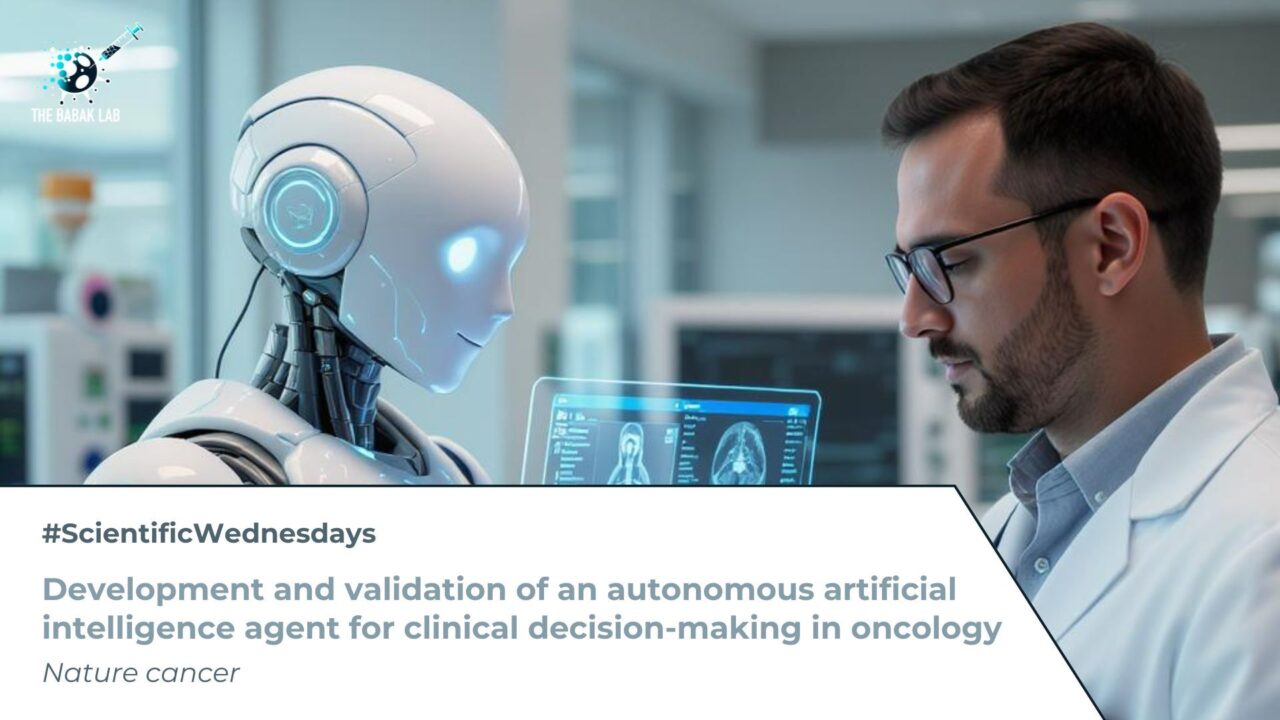
Excited to share a recent publication in Nature Cancer that marks a major step toward AI-assisted clinical decision-making in oncology. A GPT-4–based autonomous AI agent was developed to support personalized decision-making in oncology using multimodal tools (such as Vision Transformer, MedSAM, PubMed, OncoKB).
Key Findings:
The system demonstrated strong performance across several metrics when evaluated on 20 realistic multimodal patient cases:
87.5% success rate in selecting and applying appropriate tools
91.0% accuracy in clinical decision-making
75.5% correctness in citing relevant oncology guidelines
Notably, the tool-augmented system improved decision-making accuracy from 30.3% (GPT-4 alone) to 87.2%.
Conclusion:
Integrating large language models with domain-specific tools and structured medical knowledge significantly enhances the reliability and accuracy of clinical decision support systems. This modular, tool-based approach offers a transparent and practical framework for deploying AI in precision oncology—narrowing the gap between general-purpose AI and clinically robust applications.
The future of medical AI lies not only in access to information, but in its ability to reason, strategize, and deliver evidence-based insights.
Image generated with Freepik AI (www.freepik.com).”
Title: Development and validation of an autonomous artificial intelligence agent for clinical decision-making in oncology
Authors: Dyke Ferber, Omar S. M. El Nahhas, Georg Wölflein, Isabella C. Wiest, Jan Clusmann, Marie-Elisabeth Leßmann, Sebastian Foersch, Jacqueline Lammert, Maximilian Tschochohei, Dirk Jäger, Manuel Salto-Tellez, Nikolaus Schultz, Daniel Truhn, Jakob Nikolas Kather
You can read the Full Article on Nature Cancer
Maria (Masha) Babak, Assistant Professor at City University of Hong Kong, shared this post, adding:
“No doubt, AI is already assisting in many aspects of our daily lives. Integrating AI into clinical decision-making could significantly accelerate data processing, enabling doctors to analyze complex data faster and arrive at the best treatment options more quickly.”
More posts featuring The Babak Lab